
Explaining the Pre-2000 Vehicle Model Year Threshold
An ELD plugs into a truck’s diagnostic port to track drive time and distance via engine synchronization under Technical Standard 1.3. Because older trucks do not possess the required data bus infrastructure, an exception is granted based on the age of the vehicle.

The 1999 and Older Model Year Rule
Vehicles with a manufacturing model year of 1999 or older are exempt from the electronic logging mandate. Drivers operating these older trucks must still follow maximum daily driving limits. However, they are permitted to record their duty status using standard paper logbooks continuously. This exemption recognizes that without a modern electronic control setup, a device cannot automatically record vehicle motion or engine power status to meet the synchronization standard.
Differentiating Between Engine and Chassis Year
Regulations apply this rule strictly to the vehicle chassis model year found on the vehicle identification number (VIN) on the registration. Unlike other jurisdictions, it does not matter what year the engine block was made. This distinction is critical for fleets using glider kits or rebuilt trucks.
For example, if a carrier operates a 2024 chassis that is legally retrofitted with a documented 1998 engine, the vehicle does not qualify for the pre-2000 exemption because the chassis is modern. On the other hand, an older 1995 chassis retains its exempt status regardless of subsequent engine replacements.
Providing Documentation During Inspections
Because the exterior of a rebuilt truck or unique configuration often looks identical to a fully regulated modern vehicle, drivers must be prepared to verify their exemption status during scale stops and roadside checks. Carriers must also keep all vehicle configuration paperwork at their main office.
Drivers can make roadside stops faster by keeping their vehicle registration paperwork readily accessible in the cab. Showing clear proof of the vehicle’s model year via the VIN prevents disputes with officers and avoids out-of-service fines.
Decoding the Short-Haul 160-Kilometer Radius Criteria
The short-haul exception is the most common way to skip using an ELD. It lets local delivery drivers, construction teams, and local haulers work without a daily logbook. To use it, they must stay within a small local area and follow tight structural limits.
Understanding the Distance and Rest Limits
To qualify for this exemption under Section 77 of the regulations, drivers must meet specific conditions daily:
- Distance boundary. Operations must remain strictly within a 160-kilometer radius of the driver’s normal work reporting location (home terminal).
- Reporting location. Drivers must begin and end their shift at the exact same reporting location every single day.
- Core rest requirement. Drivers must return to that location daily to begin a minimum of 8 consecutive hours of off-duty rest.
Going past the distance limit ends the exception for that day. If a driver breaches the 160-kilometer boundary by any amount, they must complete a standard daily log for that shift. Additionally, the flexible “8 days out of a rolling 30-day window” paper logging buffer found in other jurisdictions does not exist; any overage requires an immediate record of duty status for the day. The operator must be able to account for their hours or carry records for the previous 14 consecutive days to satisfy roadside inspection rules.
Driveaway-Towaway and Agricultural Rules
Specific operational categories are exempt from electronic logging mandates based on the nature of the transportation service being performed. The law provides exceptions for specific operations to keep specialized logistics moving smoothly.
Driveaway-Towaway Operations
An exception is given when the truck being driven is the actual product being delivered. This driveaway-towaway rule applies when hauling an empty commercial vehicle — like driving a new box truck from a factory to a dealer or moving a motorhome as part of a sale or transport service.
To qualify, at least one set of wheels of the vehicle being transported must remain on the surface of the roadway. The carrier does not permanently run the truck as part of a standard fleet delivery service. Because of this, a permanent hardware installation is not required, and paper logs are legally permitted. Drivers under this rule must still follow daily HOS limits and carry their supporting paperwork and logs from the preceding 14 days.
Agricultural Commodity Realities
Farm haulers must follow standard tracking rules. The broad 150 air-mile agricultural exemption found in other countries does not exist under Canadian federal regulations. Individual provinces sometimes offer small local rules for in-province farm trips. However, any commercial run that crosses a provincial or international line must follow standard logging requirements completely. Assuming that a farm cargo type grants a total exemption will lead to fines at the scales. Fleet managers must check local provincial permit rules to verify their compliance status.
Legal Documentation and Roadside Inspection Rules
Operating under an exception does not protect truckers from roadside checks. Drivers must be ready to prove their exempt status to officers at inspection stations and scales. Keeping clean records in the cab avoids delays and prevents unnecessary out-of-service orders.
Carrying Required Onboard Material
Even when exempt from digital hardware, specific physical papers must remain inside the commercial vehicle cab at all times. Missing these required regulatory items results in an immediate compliance violation.
Drivers operating under a temporary or vehicle-based exemption must carry the following materials:
- The formal exception papers. A printed or digital copy of the specific rule or permit that authorizes the exemption for that trip.
- Vehicle registration records. Official paperwork showing the vehicle chassis model year via the VIN if operating under the pre-2000 chassis exemption.
- Blank paper logs. A backup supply of standard graph-grid paper logs sufficient to record a driver’s duty status for a minimum of 15 days if a local limit is breached.
Navigating the Roadside Interview
When an enforcement officer requests an electronic logging device record, the driver must clearly articulate which exemption they are operating under. Drivers must understand their exact regulatory status and be trained to explain it confidently.
For instance, a short-haul driver should inform the officer that they only work within a 160-kilometer radius of their home terminal. They should note that the company keeps their official daily time records at the main office and that they return daily to complete their required core rest. Providing a clear, professional explanation prevents the officer from assuming the vehicle is simply missing an ELD.
Expediting the Compliance Check
Speed up the inspection process by keeping all required documentation readily accessible. When an officer walks up to the cab, the driver should have the exception documentation, vehicle registration, and active driver credentials ready. Showing organized records demonstrates professional oversight and gets the driver back on the road quickly.
Managing Mixed Fleets and Exempt Profiles
Operating a commercial fleet involves a combination of regulated routes and exempt operations. Fleet managers need a system to track varying driver profiles independently, to check that each vehicle has the proper equipment for their legal status.
Assigning Driver Profiles in Fleet Software
Modern compliance software lets managers set up separate user profiles for different needs. Instead of using the same settings for everyone, managers should match rulesets to the specific driver assignment.
For example, a local delivery driver needs a short-haul profile that turns off automatic ELD alerts. An extra-provincial driver needs a fully active logging profile. Matching these software settings to real jobs avoids tracking errors and keeps fleet data clean.
Tracking the Transition From Exempt to Non-Exempt Status
When a job changes — like a short-haul driver taking an extra-provincial run past the local boundary — the office must track it closely. Under regulations, the moment a driver exceeds the 160-kilometer radius, they must immediately complete a standard record of duty status for that shift.
Fleet managers should use software dashboards to log every time a driver goes past short-haul limits. Tracking this on a timeline ensures the company can monitor operations continuously and transition the vehicle to active electronic logging tracking immediately when required by daily operational changes.
Maintaining Unified Records for Audits
During a facility safety audit, a carrier must show a complete history for every driver on the payroll. A fleet cannot show ELD files for some drivers and ignore paperwork for exempt staff.
Office teams must save local timecards, vehicle registration records for pre-2000 trucks, and standard ELD files in one database. Storing these records systematically ensures the fleet can instantly back up its choices during a safety audit.
Strategic Value of HOS247 ELD Platforms
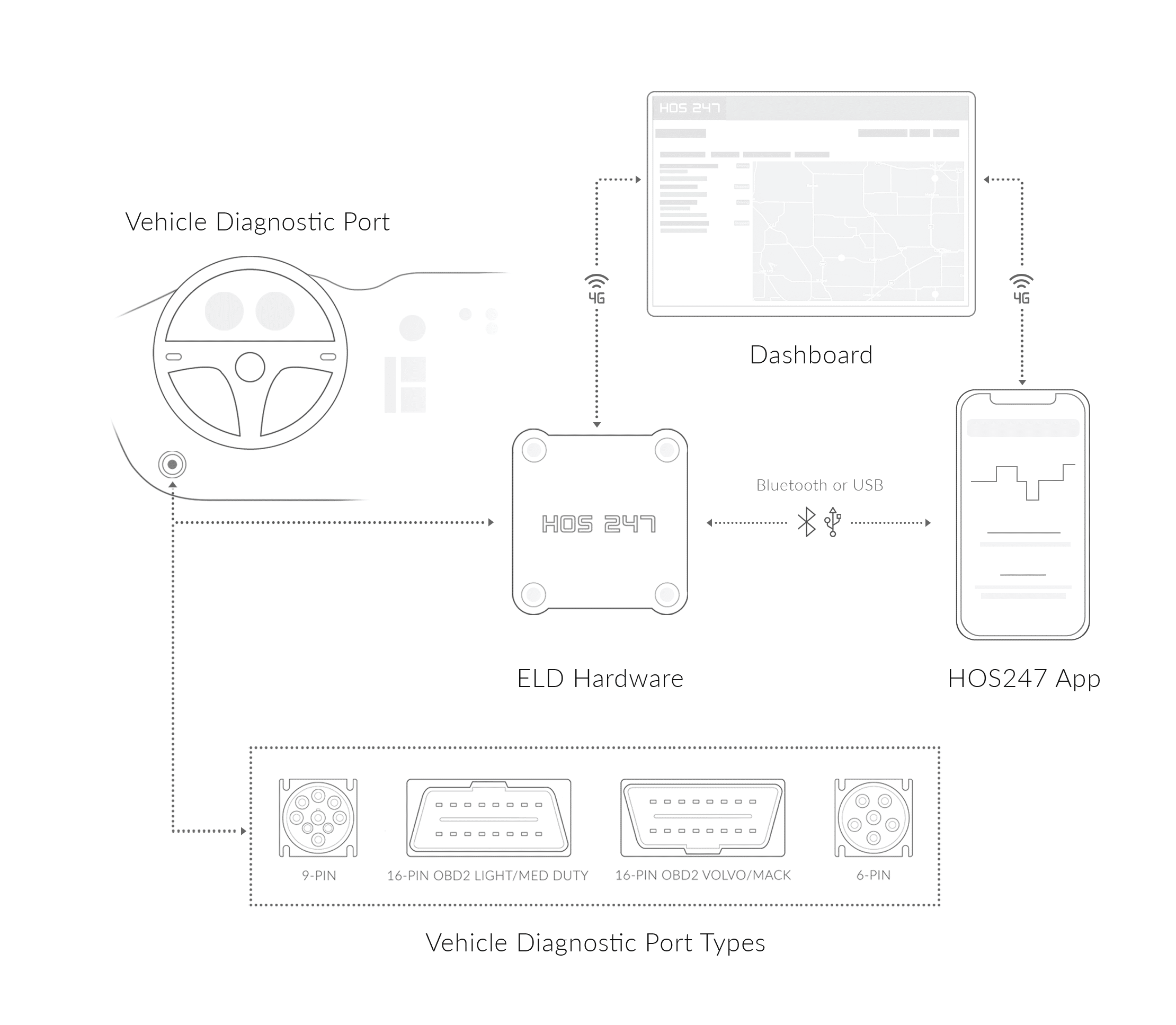
Managing a mixed commercial fleet requires a technology partner that offers both high-level visibility and flexible compliance management. The HOS247 platform provides motor carriers with the tools necessary to oversee both fully regulated and exempt driver profiles through a single, intuitive system, offering several operational benefits:
- Stable hardware performance. Units plug firmly into the diagnostic port to prevent data gaps and withstand standard commercial vehicle vibrations.
- Easy-to-use software. Intuitive driver application interfaces let personnel record data accurately with minimal training.
- IFTA distance calculations. Reduce administrative hours by letting the system calculate precise province-by-province distance data to simplify quarterly fuel tax reporting.
- Multilingual support. Expert technical assistance available in English, Spanish, Russian, and Polish helps drivers resolve software questions directly while on transit routes.
- Reliable callback safety. If a call drops mid-conversation, support teams promptly phone the customer back so drivers never have to explain their technical issue a second time.
- Transparent pricing. Manage operating budgets confidently with straightforward monthly plans that operate completely free of hidden fees or long-term contracts.
- Two-week trial period. Test the compliance system securely under real road conditions using a 14-day trial backed by a hassle-free refund policy.
As operations grow, fleets often move trucks from local routes to long-haul lanes. The HOS247 platform supports this growth with flexible setups. Fleet owners can activate full tracking on existing hardware when a driver switches to permanent long-haul trips. This eliminates the need to buy new hardware.

Mastering ELD Exemptions for Fleet Efficiency
Understanding specific legal exceptions allows commercial operations to use their compliance resources efficiently. Motor carriers can avoid unnecessary hardware expenses by identifying exactly which vehicles require permanent digital tracking and which assets qualify for alternative manual recordkeeping. Additionally, administrators can simplify daily dispatching when they know exactly how geographic boundaries, operational windows, and mechanical chassis configurations directly affect highway regulations.
Documenting Transport Canada ELD exemptions is crucial for maintaining clean carrier safety profiles and preventing expensive operational downtime. Applying the correct recordkeeping standard to every single route helps fleets track documentation and manage operational data accurately. This careful oversight prevents costly roadside fines, protects the carrier’s safety rating, and keeps specialized freight moving forward without interruptions.
Automated logging systems help managers run mixed fleets without manual recordkeeping errors across vehicle classes. Motor carriers build more profitable businesses by choosing dependable hardware that keeps operators safe, fully trackable, and focused entirely on the road ahead.
A Note to Our Readers on Compliance
This article is intended for informational and educational purposes only. It is not a substitute for official regulatory guidance or legal advice. HOS and ELD regulations are complex and subject to change and interpretation by enforcement authorities. Please always refer to official sources for the most current and accurate information.

As an expert in B2B and B2C sales, I’ve dedicated myself to perfecting sales processes and client retention strategies in the logistics and trucking industry. I have significantly contributed to the expansion of the ELD service, catering to retail and wholesale clients in need of HOS247 ELD solutions. My unwavering commitment to implementing state-of-the-art sales techniques and technologies ensures the continuous growth and success of businesses I work with.









HOS247 Provides a Top-Rated Compliant ELD App for iPhone There are many ELD apps on the market. Unfortunately, only a fraction of those are reliable. When trying to choose the best vehicle logbook app for iPhone, it is important to
Best ELD for Hotshot Trucks in Canada Transport Canada’s ELD mandate is on progressive enforcement period. To comply with its regulations, drivers will have to use certified electronic logbooks to keep records of duty status once the mandate is fully

Benefits of HOS247 Electronic Logs Besides helping drivers and carriers meet e-log compliance, HOS247 is a top-rated DOT electronic logbook provider highly trusted by fleets and owner-operators alike. The benefits of trusting HOS247 to help maintain electronic logs are many