
The “Brain and Body”: How Modern E Logs Actually Work
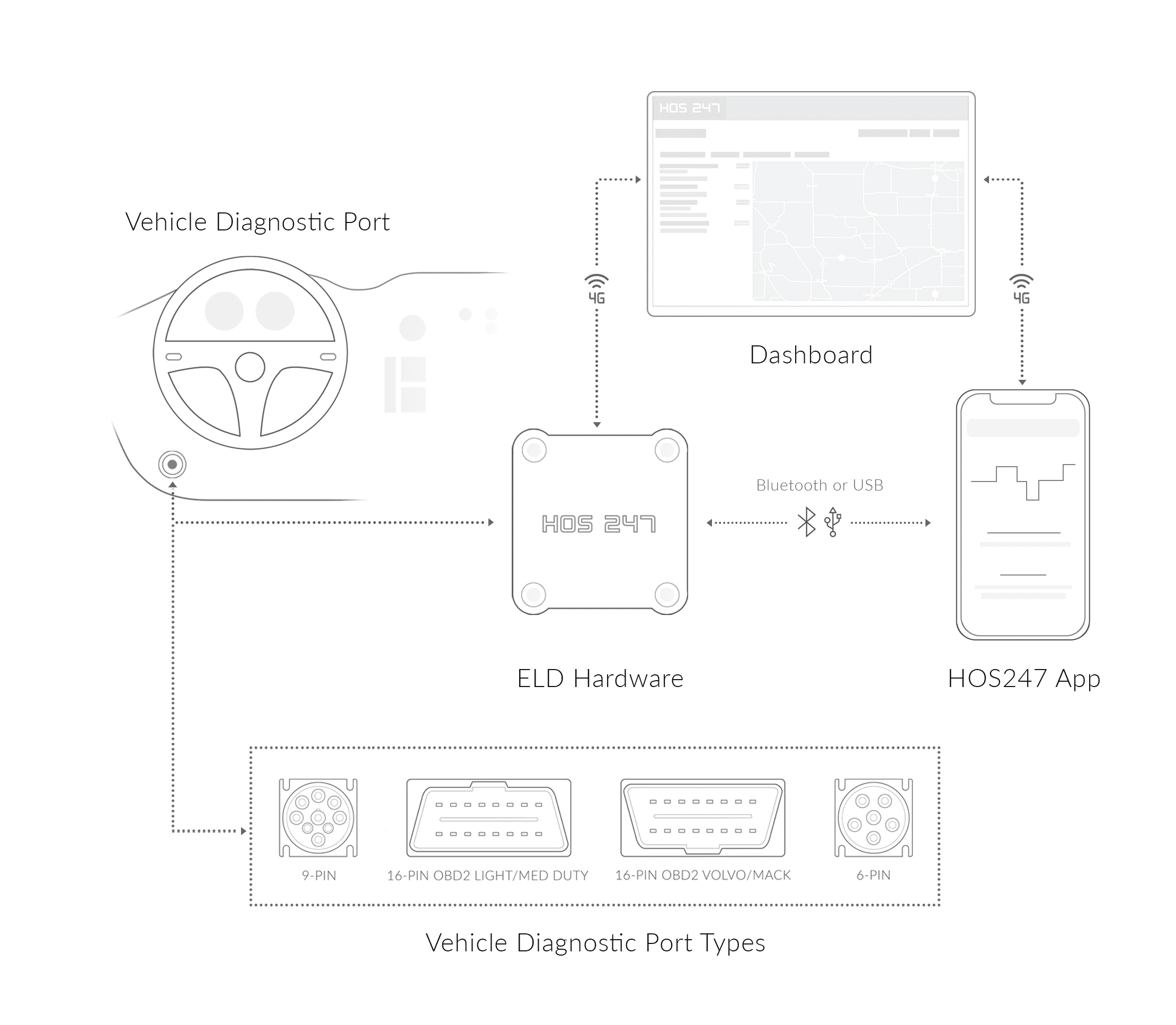
To understand how to protect your fleet, you must look at your compliance tools as a synchronized ecosystem. A legally compliant system is not a single item you download from an app store. It requires two distinct components working together flawlessly: the physical hardware (the body) and the digital software (the brain).
Integral Synchronization
The foundation of this system is a strict legal standard. The hardware device must plug directly into the truck’s diagnostic port, such as a J1939 or OBDII connection. This unit pulls raw data directly from the vehicle’s computer. It accurately tracks the engine power status, vehicle motion, and total miles driven completely automatically, without requiring any manual input from the driver.
The Software Interface
The mobile application installed on your tablet or smartphone acts as the intelligence of the operation. It receives that raw engine data and translates it into the familiar visual grid graph. When the hardware detects that the truck has reached a speed of eight kilometers per hour, the software automatically shifts your duty status to “Driving.”
Understanding this physical connection highlights a critical compliance rule. Mobile apps that rely entirely on your phone’s internal GPS for tracking are strictly illegal. If your system does not physically plug in and speak directly to the engine’s computer, it is not a compliant electronic logging device.
The High Cost of Low-Quality Electronic Logging Devices
Many drivers are currently frustrated with their compliance systems because they chose initial savings over long-term reliability. Many fleets initially select providers offering free hardware, only to discover the severe hidden operational costs later on. Look out for:
- Connection failures. Cheap, third-party Bluetooth dongles often vibrate loose or frequently drop their wireless connection to the display tablet. When the physical hardware stops talking to the software interface, the system generates an “Unassigned Driving” error. This specific error is one of the top audit triggers for safety officials in 2026.
- The contract trap. Providers offering free equipment usually subsidize that cost by locking fleets into rigid, multi-year data contracts. If the cheap hardware breaks or constantly malfunctions, the driver is legally responsible for the resulting logbook errors but remains financially trapped in the long-term software agreement.
- Support delays. Discount providers often cut overhead by relying on automated chatbots or email-only ticketing systems. When a driver experiences a technical glitch at a scale, waiting 24 hours for an email response is not a viable option. Lack of immediate, live support directly translates to extended inspection times and lost driving hours.
- Roadside transfer failures. A low-quality system may record your hours correctly but fail when it is time to electronically transfer the data file to an inspector via the prescribed Canadian transfer methods. When the digital transfer drops or times out, safety officials are forced to conduct a manual review of your screen, significantly extending the length of the inspection.
- Hidden software fees. Companies that advertise rock-bottom subscription rates often charge extra for essential fleet management tools. Features like automated IFTA reporting, vehicle diagnostics, or even basic electronic DVIRs are frequently locked behind expensive premium paywalls, making the final monthly bill much higher than originally advertised.
- Stagnant firmware. Low-quality providers rarely invest in continuous software development. Running an application with outdated firmware leaves your fleet vulnerable to technical violations during a routine compliance review.
The true cost of an electronic logging device is measured in consistent uptime, transparent billing, and accessible customer support. Paying a fair price for properly engineered hardware saves fleets thousands of dollars in potential fines, hidden fees, and forced downtime.
Essential Features of a Top-Tier System
A reliable compliance platform must handle the complex rules of commercial driving automatically. Since basic hours tracking is a universal legal requirement, evaluating a new system means looking for the advanced tools that actively manage your daily workflow, including:
- Predictive violation alerts. Rather than simply flagging an error after it happens, a smart application acts as a digital co-driver. It provides proactive audio and visual warnings well before you hit your 13-hour driving limit, 14-hour on-duty limit, or the end of your 16-hour elapsed shift window, allowing you to plan your stops safely.
- Robust offline mode. Commercial routing frequently takes drivers through remote areas and cellular dead zones. The software must continue to record and store engine data locally on the physical device, then automatically sync that data to the cloud the exact moment a cellular connection returns.
- One-click inspection mode. The roadside reality requires a fast and secure data transfer. A top-tier system allows you to send your records to an enforcement officer via encrypted email or, if supported, a local transfer (Bluetooth/USB). It should also feature a locked screen mode that protects your private fleet routing information from the inspector’s view.
- Automated IFTA reporting. Calculating fuel taxes manually is a massive drain on administrative time. Premium software tracks your jurisdictional mileage automatically as you cross state and provincial lines, turning a complex quarterly chore into a simple, highly accurate report.
- Real-time engine diagnostics. High-quality hardware reads diagnostic trouble codes (DTCs) directly from the vehicle’s computer. This allows the system to alert you and your dispatch team to minor mechanical faults early, helping prevent a small issue from escalating into an expensive roadside breakdown.
A well-designed system significantly reduces your overall administrative workload. By automating these daily tasks, it transforms a mandatory federal requirement into a highly valuable fleet management asset.
Mastering the Back-Office Audit Trail
While drivers interact with the software interface out on the road, dispatchers and safety managers rely entirely on the web portal to keep the company legally protected. A premium compliance platform must bridge the gap between the cab and the office, providing back-office staff with clear, actionable data rather than a confusing wall of numbers.
Managing Unassigned Driving Events
One of the most critical back-office tasks is reconciling unassigned miles. When a mechanic takes a truck for a test drive or a yard hostler moves a trailer across the terminal, the engine generates drive time that is not attached to a specific driver’s profile. Safety managers are legally required to review these events daily.
If a platform makes it difficult to filter and resolve these events, unassigned miles will quickly pile up. During a National Safety Code (NSC) compliance review, an excessive amount of unassigned driving is an immediate red flag that triggers deeper auditing. High-quality software provides a dedicated, intuitive dashboard that allows managers to quickly assign these events to the correct personnel or add the required annotations with just a few clicks.
Ensuring Tamper-Proof Original Records
When a dispatcher or safety manager makes a legal edit to a driver’s logbook, the software must handle that data transparently. The commercial vehicle drivers hours of service regulations mandate that the original, automatically recorded engine data remains completely intact and visible at all times. The system must display the newly edited version directly alongside the original record.
If an application allows a user to permanently delete or overwrite actual driving time, the entire system is non-compliant. Maintaining a clear, tamper-proof audit trail is a motor carrier’s best defense during a comprehensive safety review, proving to auditors that the fleet handles corrections legally and transparently.
Surviving 2026 Certification Standards with a Certified E-Log Solution
In 2026, Transport Canada and its accredited certification bodies monitor the List of Certified ELDs. Unlike the U.S. self-certification model, a device in Canada must be independently tested. If a device is found to be non-compliant with the CCMTA Technical Standard, its certification is revoked, and it is moved to the “No Longer Certified” list.
If your provider is revoked, you must follow the strict regulatory timeline to maintain your operating authority:
- The 14-day replacement rule. Under federal regulations, once a motor carrier becomes aware that their ELD is no longer certified or is malfunctioning, they have a maximum of 14 days to repair or replace the unit.
- The “home terminal” exception. If a device fails while a driver is on a trip, the 14-day clock applies, but the driver is permitted to finish their planned trip on paper logs and replace the device upon returning to their home terminal (if the trip exceeds 14 days).
- No automatic 60-day grace period. Do not rely on the 60-day “grace period” common in the U.S. (FMCSA). In Canada, once a device is decertified, provincial enforcement (MTO, SAE, etc.) can technically cite you for “No Record of Duty Status” if you continue to use it beyond the 14-day repair/replacement window.
- Roadside transfer reality. While U.S. enforcement uses the “ERODS” web portal, Canadian roadside inspections in 2026 rely primarily on S/MIME encrypted email or a direct on-screen display of the “Compliance Print.” If your software cannot generate the specific Canadian .csv output file for email transfer, it is considered non-compliant.
- The “malfunction” paper log protocol. If your ELD certification is revoked or the hardware freezes, you must immediately revert to paper logs. You are required to possess a supply of blank paper daily logs sufficient for at least 15 days. You must also reconstruct your records for the previous 14 days on these paper grids to show a complete history to an inspector.
Why HOS247 Provides Top E Log Solutions for Truck Fleets
As Transport Canada continues to update its list of certified devices and refine compliance standards, fleets need a dependable partner to support their business. HOS247 provides a proven solution to dropped connections, frozen tablet screens, and unreliable logging systems.
We built our platform to deliver the stable integration that modern fleets require, keeping drivers compliant and productive without the daily technical frustrations.
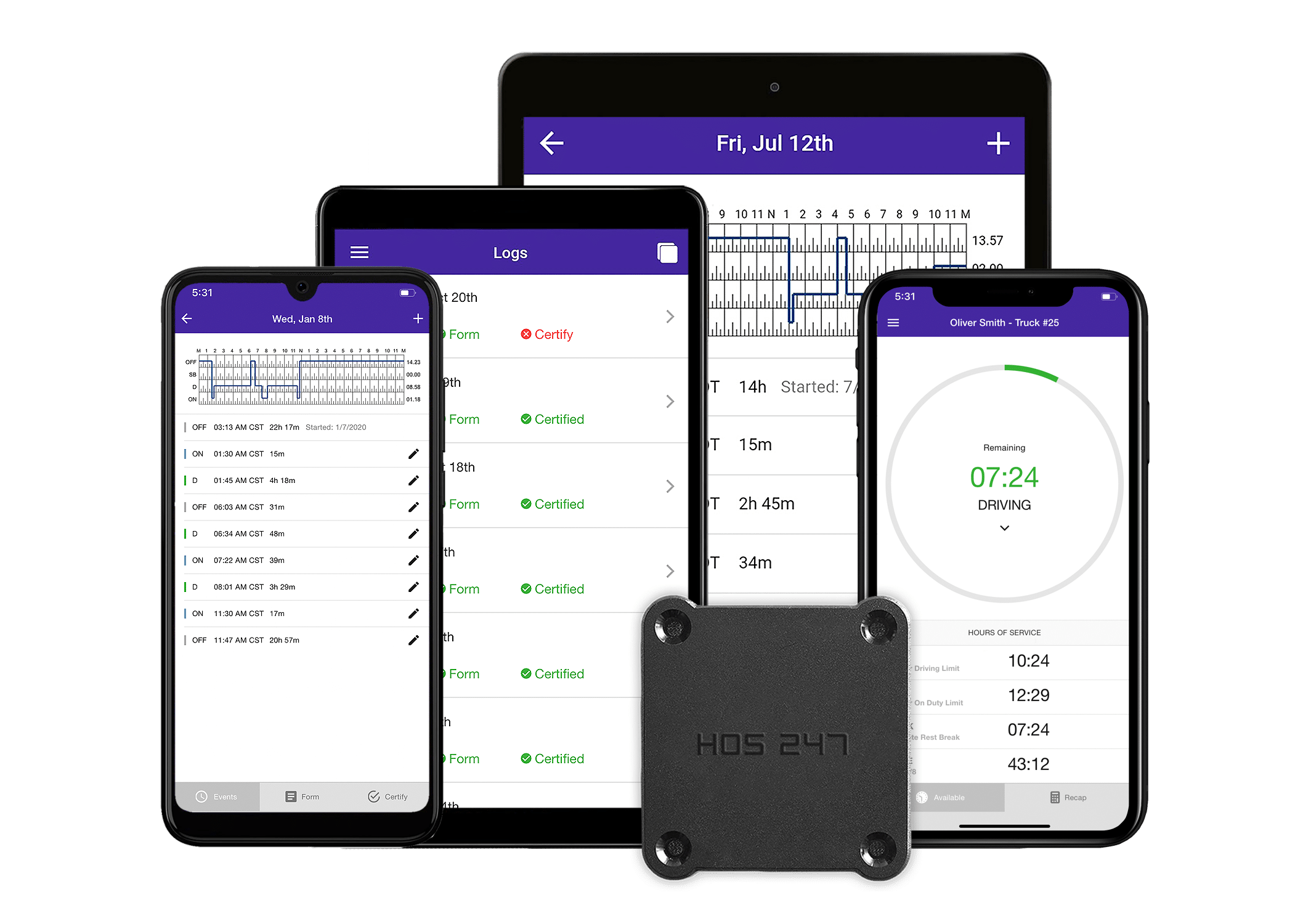
- Engineered stability. We provide fully vetted, proprietary hardware designed to maintain a rock-solid Bluetooth handshake with our intuitive driver app. This ensures the physical device and the digital interface communicate flawlessly, preventing the data gaps that often complicate National Safety Code (NSC) audits.
- Hardware warranty. We stand behind the durability of our equipment in the harsh environment of a commercial cab. Every telematics device comes with a one-year free replacement warranty to keep your trucks moving.
- Bring your own device (BYOD). Our application is fully compatible with the Android and iOS smartphones and tablets you already own. This flexibility saves fleets money on expensive proprietary screens and lets drivers use the technology they are already comfortable with.
- Driver-centric interface. The app features large touch targets and high-contrast visuals to reduce input errors at the end of a long shift. We also include a dedicated night mode to minimize eye strain during late-night driving, making duty status changes fast and frustration-free.
- Advanced fleet tools. The HOS247 platform moves beyond basic compliance to include real-time GPS tracking, automated IFTA mileage calculations, electronic DVIRs, and idle monitoring. These tools help reduce fuel costs and streamline dispatching operations.
- Top-tier multilingual support. Trucking is a demanding, around-the-clock job. When a driver has a critical question at a scale, our support team actually answers the phone. We provide expert, live assistance seven days a week in English, Spanish, Russian, and Polish.
- No-contract freedom. We believe in earning your business through reliable performance rather than placing you in a restrictive legal agreement. Our flexible, month-to-month plans give you the freedom to scale your fleet without worrying about hidden hardware fees or early cancellation penalties.
HOS247 provides the peace of mind that comes from using a fully supported, road-tested system. Choosing a provider with transparent business practices and rugged technology ensures your operations run smoothly day after day.

How to Switch Providers Without Fleet Downtime
Since the majority of carriers shopping for new electronic logging devices are actively looking to replace a failing provider, understanding how to transition smoothly is critical. Switching compliance platforms requires logistical planning, but it does not have to result in lost loads or frustrated drivers.
Timing Your Contract Exit
Before purchasing new equipment, carefully review the cancellation terms of your current provider. Many companies require a strict 30-day or 60-day written notice prior to your exact contract renewal date. If you miss this specific window, they will automatically lock your fleet into another multi-year agreement. To avoid paying double subscriptions, time your exit so that your new hardware arrives a week before your old contract officially terminates.
The Hardware Swap Logistics
Replacing the physical telematics devices requires careful coordination with your maintenance schedule. You cannot legally have commercial trucks operating without a functioning device plugged into the engine. The most efficient approach is to plan the hardware swap during scheduled preventative maintenance windows or over a weekend when the majority of the fleet is parked at the terminal. During this transition week, remind drivers to diligently maintain their required 14 days of paper logs, as the new software will need time to sync and populate their recent driving history.
Driver Onboarding and Acceptance
The success of any new technology rollout relies entirely on driver adoption. Drivers are naturally skeptical of new software, especially if they have been burned by glitchy applications in the past. To ease the transition, choose a provider that offers an intuitive, driver-centric interface and a “Bring Your Own Device” option. Allowing drivers to use their own familiar smartphones or tablets significantly reduces the learning curve. Provide them with straightforward training materials and ensure they know exactly how to contact live customer support before they take their first dispatch with the new system.
Frequently Asked Questions About Electronic Logs
What are e logs required to track automatically?
An electronic logging device is required to automatically track engine power status, vehicle motion, total miles driven, and engine hours. It must also automatically switch a driver to “Driving” status when the commercial vehicle exceeds a speed of eight kilometers per hour.
Can I edit my driving time?
No. Automatically recorded driving time cannot be shortened or deleted by either the driver or the motor carrier. You can only add annotations to explain the time or edit non-driving statuses, such as sleeper berth or on-duty time.
What happens if my system breaks while I am driving?
You must notify your motor carrier immediately of the malfunction. You must then reconstruct your record of duty status on paper for the current day and the previous 14 days. You are legally limited to using paper logs for a maximum of 14 days until the device is repaired or replaced with a certified ELD.
Are Transport Canada certified devices guaranteed to never lose their certification?
No. Unlike the U.S. self-certification model, Canadian devices undergo rigorous third-party testing. However, if a device is later found to be non-compliant with the technical standard, its certification can be suspended or revoked. This is why it is crucial to choose an established provider with a history of verified compliance and active firmware updates.
Staying informed on these operational rules is your best defense against unexpected roadside violations. Knowing exactly how your technology interacts with Canadian federal and provincial law prevents easily avoidable administrative citations.

Upgrade Your Fleet’s Reliability Today
Settling for a glitchy, unreliable logging system is a direct risk to your livelihood and your motor carrier authority. Operating a commercial vehicle requires technology that works as hard as you do, and relying on outdated hardware is a risk modern fleets simply cannot afford.
As a commercial driver, you know exactly what are e logs. It is time to evaluate if your current provider is truly protecting your business. You need a system that acts as a dependable digital co-driver rather than a daily administrative burden.
Stop fighting with dropped connections and poor customer service. Schedule a demo or start your no-contract trial with HOS247 today to experience a complete compliance system built for the realities of the road.

I’ve co-founded, built and managed several transportation-related businesses. Now, I’m a founder and CEO of HOS247 – an AI Transportation Platform for trucking companies, freight brokers and other logistics operations. We are transitioning old-style operations to technology-advanced logistics entities and help them to grow their businesses. ELDs (electronic logging devices), fleet tracking and management 2.0 combined with AI-powered dispatch tools.










You’ve got enough on your mind when you’re rolling down the highway. The last thing you need is the headache of complicated logging systems or the stress of a Transport Canada inspection. Whether you’re a seasoned pro or new to

Transport Canada has mandated that most commercial drivers who are required to maintain records of duty status must do so through an electronic logging device come January 1, 2023. These devices help monitor drivers’ time on the road to meet

The Federal Motor Carrier Safety Administration is in charge of ensuring road safety. To that effect, drivers are allowed to drive and be on duty for limited periods. Paper records were the norm to keep records of driver’s hours of