
The New 2026 Certification Standards: What It Means for Truckers
To make informed decisions for your fleet, it is essential to understand why devices could be removed from the certified list. The standard for what constitutes a “compliant” device is subject to continuous review. The accredited certification bodies conduct ongoing surveillance to ensure technical competence and compliance with the most recent regulations.

The Canadian ELD Certification Process Explained
The most critical factor for compliance is the Third-Party Certification Model. In Canada, devices must be “Certified” and appear on the official Transport Canada registry to be legally used.
- Certified Status. These devices have passed the accredited certification body’s technical audit. The provider has proven that their “Integral Synchronization” meets strict latency requirements and demonstrated robust fraud prevention measures. Under Technical Standard 1.3, devices must also pass updated checks regarding data encryption and transfer reliability.
- Suspended/Revoked Status. If a device is found to no longer meet the technical requirements — such as failing to properly record unassigned driving time or having persistent data transfer errors — its certification is suspended. The provider is then removed from the List of Certified Electronic Logging Devices.
- Technical Standard 1.3 Compliance. By 2026, all devices must align with the latest version of the standard. This update specifically targets the reliability of the mandated data transfer methods and ensures that “ghost logs” cannot be generated through software loopholes.
The Reliability of Certified Units
A primary strength of this system is the high barrier to entry for manufacturers. Because the entire system, hardware and software combined, must be certified as a single unit, there is no room for generic “black box” components that haven’t been stress-tested.
If a hardware component fails a re-test, the certification for that specific unit is pulled. This protects you from buying a system that will get you cited during a National Safety Code (NSC) inspection. If your provider is still relying on outdated version 1.2 certifications without upgrading to the 2026 standards, your compliance status might be ticking on borrowed time.

Managing a Revoked ELD (The 8-Day Rule)
If you receive a notification that your electronic logbook provider has been removed from the List of Certified Electronic Logging Devices, you must take immediate action. Transport Canada and provincial authorities follow a strict legal protocol to ensure road safety.
The Transition Protocol
When a device is no longer certified, the replacement of the non-compliant hardware is handled through provincial and federal enforcement policies.
- Enforcement status. Motor carriers are generally required to replace a non-certified device immediately. However, during major industry-wide transitions, Transport Canada may issue specific enforcement bulletins or grace periods outlining transition timelines.
- The “Functional” Requirement. If the device stops recording engine data or malfunctions, you are no longer compliant. In this scenario, you must immediately switch to paper logs to record your hours.
- Paper log rule. Under Section 98 of the federal regulations, if the device is defective, you are legally required to reconstruct your logs on paper for the current day and the previous 14 days. You must keep a supply of blank grid graphs in the truck for this exact scenario.
The Compliance Deadline
Once any established transition window expires, the consequences are severe:
- Out of Service (OOS). The driver will be placed Out of Service according to the CVSA Out-of-Service Criteria.
- Fines. Drivers and carriers can face significant fines for failing to use a certified ELD, with amounts varying by province.
- Replacement. The vehicle cannot legally operate until a certified device from the official list is installed.
Contractual Considerations
Many fleets worry about the cost of breaking a contract with a provider that loses its certification. It is important to know that in Canada, the legal requirement is for a certified device. If a vendor can no longer provide a device that remains on the Transport Canada list, they are likely failing to meet their side of the agreement. Do not let the threat of “early termination fees” stop you from switching to a compliant, certified provider.
Future-Proofing: Wireless Roadside Inspection & The Level VIII Standard
While current compliance focuses on hardware certification, the industry is evolving toward more automated enforcement. The most significant development on the horizon is the Level VIII Electronic Inspection, a standard recognized across North America by the Commercial Vehicle Safety Alliance (CVSA).
Understanding Level VIII Inspections
The Level VIII inspection is designed to conduct compliance checks while the vehicle is in motion, without the driver having to stop or interact directly with an enforcement officer.
- How it works. As your truck passes a roadside sensor or an equipped scale at highway speeds, the ELD wirelessly transmits a “data packet” to the enforcement software.
- The Canadian Context. While Level VIII is currently in an operational test phase (primarily in pilot jurisdictions and cross-border corridors), it is a key component of the 2026 safety roadmap. For Canadian truckers, this technology is increasingly relevant for cross-border hauls and as provinces begin integrating “Smart Scale” technology into the National Safety Code (NSC) oversight process.
- What it checks. This packet typically includes your NSC number, operating authority status, and current Hours of Service (HOS) data.
The Technical Challenge
Level VIII inspections require 100% connectivity uptime. If your ELD hardware has a weak Bluetooth signal or a slow cellular modem, it may fail to transmit the required data in the few seconds you are passing the sensor. In an automated system, a “failed transmission” can trigger a red light on your transponder, forcing you to pull in for a manual, time-consuming Level I or II inspection.
This shift makes hardware quality a direct factor in your fleet’s efficiency. A device that struggles with high-speed data handshakes can lead to unnecessary delays at the scale, costing you valuable driving hours.
The Pre-2000 Exemption Update
For drivers of older equipment, the 2026 regulatory landscape remains stable but highly scrutinized.
- Exemption status. Transport Canada regulations confirm that the ELD exemption for vehicles manufactured before model year 2000 remains in effect.
- A Critical Canadian Distinction. Unlike other jurisdictions that may look at the engine’s manufacture date, Canadian enforcement focuses strictly on the vehicle’s model year. A truck with a model year of 2000 or newer is not exempt, even if it has a pre-2000 engine installed.
- Enforcement reality. Officers are now more rigorous about verifying these exemptions. Ensure your vehicle registration and paperwork are readily available and match your vehicle hardware exactly to avoid delays during a roadside check.
The trend for 2026 is clear: the era of passive compliance is ending. Whether it is through high-tech wireless handshakes or rigorous manual verification of older equipment, drivers must ensure their technology and documentation can withstand a deeper level of scrutiny.
Choosing a Survivor: Criteria for a Certified ELD
With the market consolidating as older systems fail to meet Technical Standard 1.3, choosing a provider is no longer just about price — it is about operational survival. You need a partner that ensures your data remains compliant and accessible.
When evaluating a new elog system, look for these three technical indicators:
1. Verification of “Integral Synchronization”
A compliant device must read data directly from the ECM (Engine Control Module).
- Red flag. Avoid devices that rely on “GPS-based” motion detection. GPS can lose signal in tunnels or remote areas. Canadian rules require the device to track motion based on actual vehicle data, such as wheel speed or RPM. Only a robust, certified ECM connection can do this reliably.
2. Data Transfer Success Rate
The number one reason for certification issues is the failure of the “Data Transfer” test during an inspection.
- The standard. A professional system must support the mandated Canadian data transfer methods. It should provide a clear, on-screen confirmation that the file was successfully generated and sent to the officer.
3. Proprietary Hardware Architecture
Look for providers that control their own hardware supply chain. Companies that simply resell generic, “white-label” devices often lack control over component quality. If a manufacturer changes a chip to save costs, it could inadvertently break the device’s certification status.
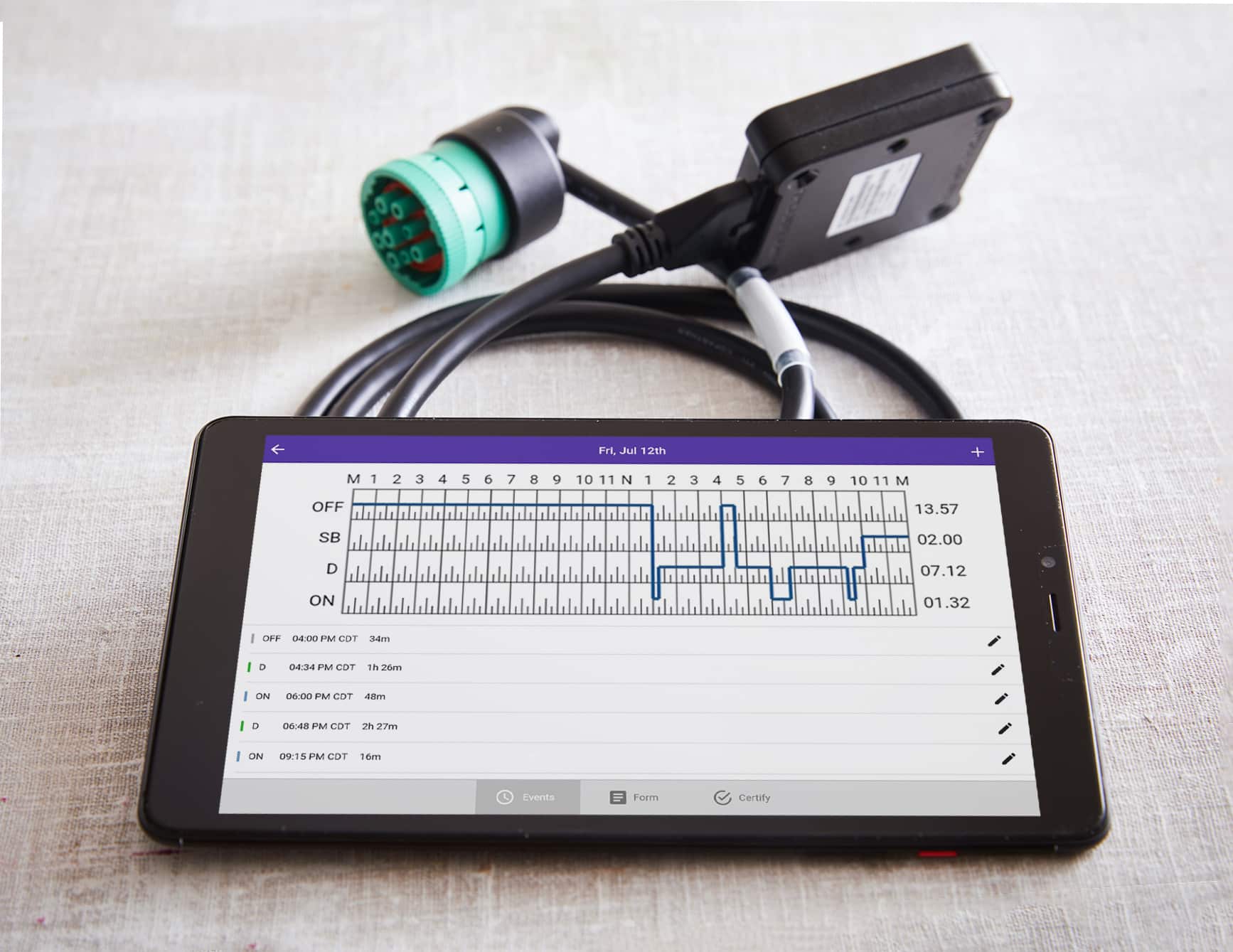
- The safe choice. Providers like HOS247 that specify and vet their own industrial-grade hardware are insulated from these risks, ensuring the device you buy today continues to meet evolving standards.
HOS247 is Built to Last
In a market defined by certification updates, HOS247 offers stability. We build infrastructure designed to meet Transport Canada’s rigorous standards. For fleets transitioning from a provider that has lost its certification, our goal is to make the switch a seamless upgrade.
Hardware That Stays Connected
Cheap plastic dongles often vibrate loose or overheat, causing malfunctions that get you flagged. We use industrial-grade hardware tested for the dust, heat, and vibrations of the road, ensuring you spend less time troubleshooting and more time moving.
Ready for the Future of Inspections
As enforcement gets faster and moves toward wireless standards, you need a system that can transfer data instantly. Our platform is built for high-speed data transfer, ensuring that whether you are at a roadside stop or passing a scale, your data is formatted correctly and ready for review.
Support That Speaks Your Language
When you are at a scale, you don’t have time for a chatbot. Our support team works 7 days a week and speaks English, Spanish, Russian, and Polish. You get live, human assistance in your own language when it matters most.
Freedom From Long-Term Contracts
We believe you should stay with a provider because the system works. HOS247 operates on a month-to-month basis with no 3-year lock-ins, putting control back in your hands.
Choosing HOS247 provides operational peace of mind. By combining industrial-grade hardware with transparent, flexible terms, you get a system that supports your business goals and keeps you ready for any inspection.

Frequently Asked Questions About New Elog Regulations

As an expert in B2B and B2C sales, I’ve dedicated myself to perfecting sales processes and client retention strategies in the logistics and trucking industry. I have significantly contributed to the expansion of the ELD service, catering to retail and wholesale clients in need of HOS247 ELD solutions. My unwavering commitment to implementing state-of-the-art sales techniques and technologies ensures the continuous growth and success of businesses I work with.








It’s a scenario every trucker in Canada dreads: you’re pulled in for a roadside inspection, the officer asks to see your logs, and your ELD won’t connect. You’re staring at a spinning wheel on your screen, trying to explain that

Managing a fleet can be challenging, from tracking their locations to preventing delays, theft, and other issues. However, there is a solution that can revolutionize fleet management: GPS trailer trackers. These devices provide motor carriers with unprecedented control over their

Truck drivers and fleet managers have found a trustworthy digital truck logbook provider in HOS247. Our team has assembled a solution that drivers can rely on; it is approved by the FMCSA and keeps accurate HOS logs with minimal effort