
California ELD Mandate vs. Federal FMCSA: What’s the Difference?
When determining your compliance needs, the first step is identifying which jurisdiction governs your current haul. While the hardware used is often the same, the software settings must reflect the specific laws of your route.
The Core Question: Do I Need an ELD in California?
For most drivers, the baseline is the Federal FMCSA rule. If you are a federally regulated, interstate commercial motor vehicle (CMV) driver — meaning you cross state lines or handle cargo intended for an out-of-state destination — you are required to use an FMCSA-registered ELD. This has been the standard for years across the United States.
However, the confusion usually starts with intrastate routes. If you never leave California, do you still need a digital log? Per California law (specifically CVC 34501.16 and Title 13 of the California Code of Regulations), the answer is a definitive yes. As of January 1, 2024, California officially aligned with the federal mandate, requiring nearly all intrastate commercial drivers to transition from paper logs to an ELD in California.
The Key Differentiators
While California has adopted the requirement to use an electronic device, it has not abandoned its unique Hours of Service limits. This creates a situation where a driver might be legally using an ELD device in California, but if that device is only programmed for federal “interstate” rules, the driver could still be cited for an HOS violation.
The primary distinction lies in how the “clock” runs. For example, federal rules allow for 11 hours of driving within a 14-hour window, while California intrastate rules allow for 12 hours of driving within a 16-hour window. If your device isn’t configured for California ELD trucking specifically, it might flag you for a violation you haven’t actually committed—or worse, fail to warn you before you break a state-specific rule.
The real challenge isn’t just owning a device; it’s ensuring that your provider supports the specific “California Intrastate” rulesets required by the CHP. Whether you are hauling produce through the Central Valley or containers in Long Beach, your logs must reflect the reality of California’s unique legal landscape.

Understanding the California HOS Rules for Trucking
Providing expert-level value means understanding that a compliant ELD device in California is only as good as the software it runs. The rules for intrastate drivers are more flexible in some areas but more rigid in others compared to federal standards. If your device isn’t configured for these specific nuances, you risk “false positives” on violations or, worse, missing a real violation that a CHP officer will certainly catch.
The 12-Hour Driving Rule
One of the most notable differences is the driving limit. While federal rules restrict interstate drivers to 11 hours of driving, California intrastate rules allow for 12 hours of driving. This must occur within a 16-hour on-duty window (compared to the federal 14-hour window), provided the driver has had 10 consecutive hours off duty. This extra hour can be the difference between making it home or spending the night at a rest stop.
The 80-Hour / 8-Day Rule
California utilizes a unique cumulative cycle. While most interstate carriers use the 70-hour / 8-day limit, California intrastate drivers are permitted to work up to 80 hours in an 8-day period. This is a significant increase in available capacity, but it requires precise tracking. A generic ELD may start “beeping” at you once you hit 70 hours, creating unnecessary stress for a driver who is perfectly legal under state law.
The 30-Minute Break Nuance
Under federal rules, a break is required after 8 hours of cumulative driving. However, California’s labor landscape adds a layer of complexity. While federal preemption has affected how meal breaks apply to interstate drivers, California intrastate drivers generally still follow the state-mandated requirement: a 30-minute break after 5 hours of on-duty time. Your California ELD should be capable of alerting you based on these state-specific triggers.
Split-Sleeper Berth
California aligns with the federal split-sleeper provision, allowing drivers to split their required 10 hours of off-duty time. This usually involves a 7/3 or 8/2 split, provided one period is spent entirely in the sleeper berth.
Key Takeaway: Using a generic ELD that only supports federal HOS rulesets is a quick way to get a violation during a CHP inspection. To stay safe, your system must have a dedicated “California Intrastate” ruleset pre-loaded.
Key Exemptions from the California ELD Trucking Mandate
Not every commercial vehicle operating on California highways is required to use an Electronic Logging Device (ELD). While exceptions eliminate hardware costs and manual logging, they are strictly enforced by both the California Highway Patrol (CHP) and the FMCSA.
The 150 Air-Mile (Short-Haul) Exemption
The short-haul exemption radius stands at 150 air miles (approximately 172.6 statute miles). Drivers operating within this zone do not need an ELD or a standard Record of Duty Status (RODS) if they meet the following daily criteria:
- Start and end at the same location: Report to and be released from the normal work reporting location every day.
- Observe shift limits: Return and be released within 14 consecutive hours for interstate routes (or 12 consecutive hours for California intrastate time-card compliance).
- Observe driving limits: Do not exceed 11 hours of driving time for interstate commerce (or 12 hours for California intrastate routes).
- Maintain time records: Keep accurate time cards at the home office for at least six months showing report time, release time, and total daily hours worked.
The 16-Hour Short-Haul Exception
For California intrastate operations, drivers may extend their maximum daily duty period from 12 hours up to 16 hours once per week (or once per 34-hour reset).
- Purpose: Helps local drivers handle unexpected route delays, severe weather, or loading bottlenecks without triggering an ELD violation.
- Driving Cap: Total driving time cannot exceed 12 hours within that 16-hour window.
- Rest Requirement: The driver must return to their home terminal at the end of the shift and take at least 10 consecutive hours off duty before driving again.
Agricultural Operations
Agriculture is the backbone of California’s economy, and the state provides unique relief for it. Drivers transporting agricultural commodities are often exempt from HOS and ELD requirements when operating within a 112 air-mile radius (100 nautical miles) during planting and harvesting seasons. This allows for the flexibility needed to move perishable goods from the field to the processing plant without the “ticking clock” of a standard logbook.
Pre-2000 Vehicle Exemption
California honors the federal exemption for “glider kits” or older equipment. If your truck’s engine (verified by the VIN) was manufactured before the year 2000, you are not required to use an ELD. You must, however, still maintain paper logs if you operate outside of the short-haul radius.
Keep in mind that exemptions are conditional. If you break a single rule — such as working 13 hours on a day you intended to be “short-haul” — you are retroactively required to have a log for the past seven days. For this reason, many “exempt” drivers in California ELD trucking choose to use a device anyway, ensuring they have a digital “shield” in case their route unexpectedly changes.
Beyond the Logbook: California’s CARB and Clean Truck Check Requirements
Operating in California involves more than just managing your hours; it also means meeting the nation’s strictest environmental standards. California is currently the only state that requires regular “smog checks” for heavy-duty diesel vehicles through the Clean Truck Check (formerly known as HD I/M) program.
The New Standard: Clean Truck Check (HD I/M)
Under this program, nearly all non-gasoline vehicles with a GVWR over 14,000 pounds must demonstrate that their emissions control systems are functioning correctly. This is managed via the CARB (California Air Resources Board) online portal. To stay legal, owners must:
- Report vehicle information in the Clean Truck Check database.
- Pay an annual compliance fee, which for 2026 is $32.13 per vehicle (adjusted for inflation).
- Obtain a Compliance Certificate to avoid registration holds or steep roadside fines.
Periodic Testing
Starting in 2025 and continuing through 2026, most trucks (specifically 2013+ model year diesel engines equipped with On-Board Diagnostics) must submit emissions data twice per year. By 2027, this frequency is scheduled to increase to four times per year. If your truck is older and lacks OBD, you must still provide a passing smoke opacity test performed by a credentialed tester.
Do out-of-state trucks have to comply?
Yes. Despite ongoing federal legal discussions, CARB maintains that any heavy-duty vehicle over 14,000 pounds operating on California public roads — regardless of where it is base-plated — must be registered in the CARB database, pay the annual fee, and comply with testing requirements to avoid fines exceeding $1,000.
How HOS247 Supports Your California ELD Trucking Operation
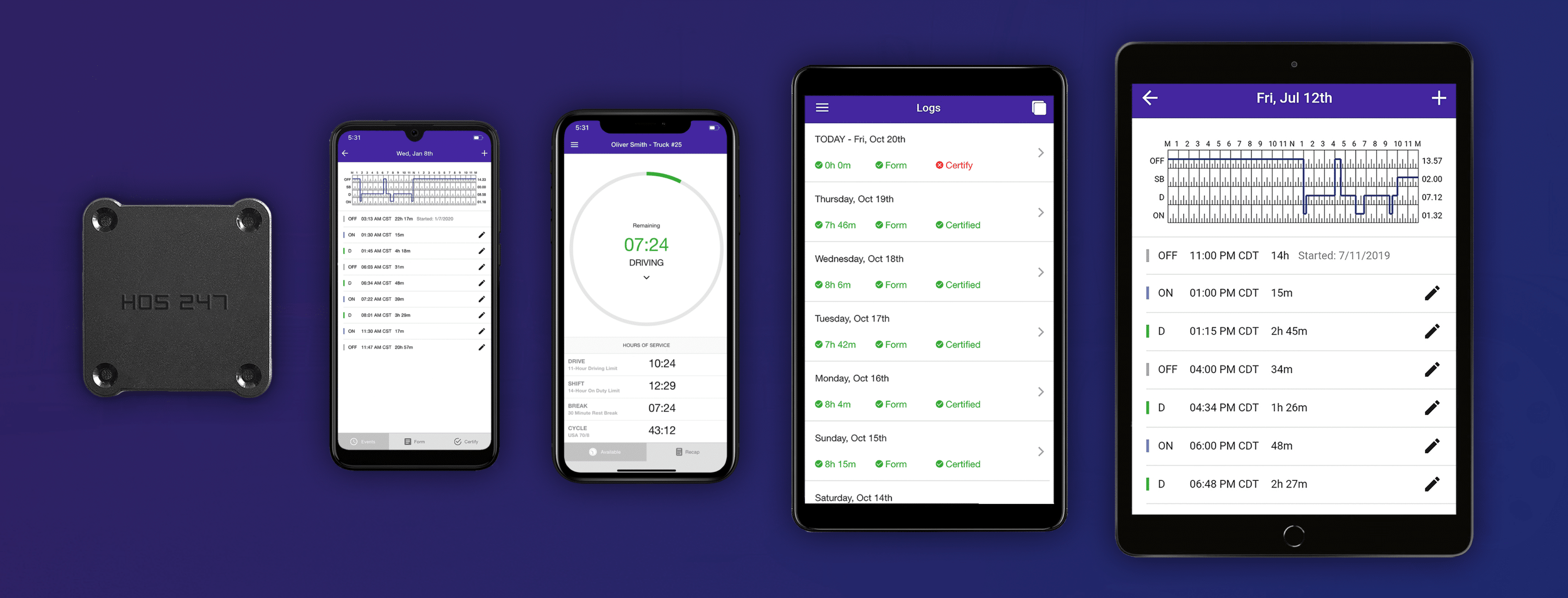
Choosing the right partner means finding a solution that understands the specific demands of California ELD trucking. HOS247 isn’t just a generic logbook; it is a specialized tool built for the complexities of the West Coast.
- Californian rulesets. We don’t force you to use federal rules when you’re driving intrastate. Our system includes pre-loaded, up-to-date California HOS rulesets. Whether you need the 12-hour driving limit or the 80-hour/8-day cycle, you simply select your rule in the app and our software handles the math.
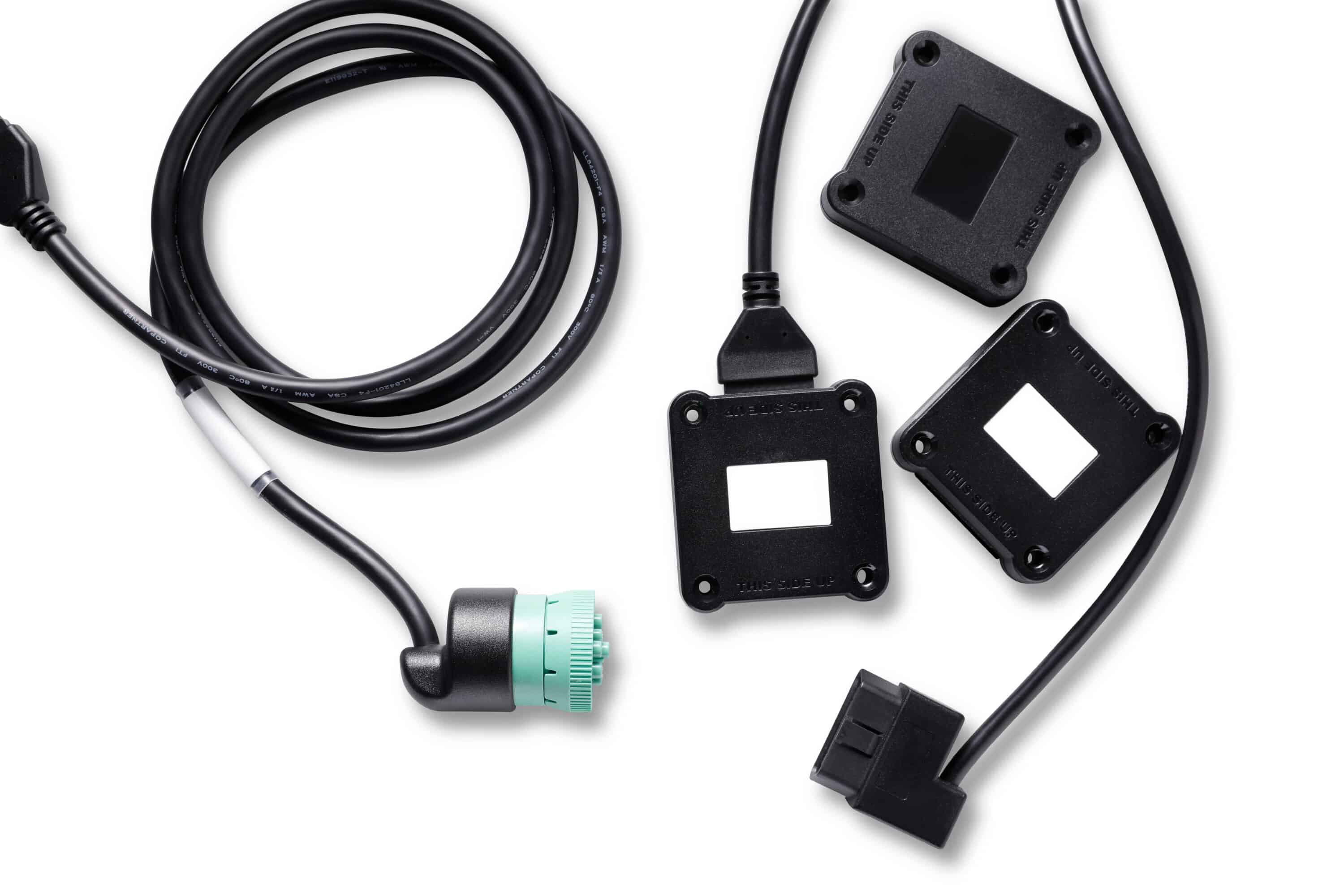
- Integrated CARB testing. The FMCSA-certified hardware connects directly to the vehicle’s engine port, reading emissions data, which is transmitted directly to CARB to obtain Clean Truck Check compliance certificates.
- Reliable, road-tested hardware. A lost connection during a CHP inspection can lead to a “failure to provide logs” citation. We have engineered our hardware for stability, using high-quality Bluetooth connections and durable components that keep your logs accurate and accessible at a moment’s notice.
- One-year hardware warranty. We stand behind our equipment. Every HOS247 ELD device comes with a one-year hardware warranty. If your device exhibits any material defects within the first year, we provide a free replacement to keep your fleet moving without extra costs.
- Top-rated multilingual support. Compliance questions don’t wait for business hours. Our support team is available seven days a week to help you navigate the 80-hour rule or the 16-hour short-haul exception in English, Spanish, Polish, and Russian.
- Our proactive callback policy. We know your time is money. You’ll never be stuck in a phone queue for hours. If you contact our support team or if a call is accidentally disconnected, our policy is to call you back immediately to ensure your issue is resolved.
- No-contract flexibility. We believe our product should earn your business every single month. HOS247 offers no-contract plans and a satisfaction guarantee, providing the flexibility owner-operators and growing fleets need without locking them into multi-year commitments.
- Risk-free two-week trial. We want you to be completely confident in your choice. We offer a two-week trial period so you can test the hardware and the app in your own truck. If it isn’t the right fit, you can return it for a hassle-free refund.
HOS247 is more than just a compliant ELD in California; it’s a reliable partner built to handle the unique challenges of the Golden State, from HOS nuances to the latest environmental reporting standards.
Buyer’s Guide for a California-Compliant ELD
Selecting an ELD device in California is a business decision that directly impacts your uptime and your bottom line. Since the California Highway Patrol (CHP) enforces the state’s unique intrastate rules with precision, “good enough” hardware often isn’t enough to avoid citations. Here is what you should prioritize when shopping for a solution.
Must-Have Feature: California Intrastate Rulesets
The most critical factor is software capability. If a provider cannot show you the specific “California 80-hour/8-day” or “California 12-hour driving” ruleset within their mobile app, it is not truly compliant for intrastate work. Using a device that only supports federal cycles will result in incorrect violation alerts and potential fines during a roadside inspection.
Provider Reputation and Support
Don’t just buy a piece of hardware; buy the support team behind it. Check reviews specifically from other truckers to see how the provider handles technical issues. In California, where regulations like the Clean Truck Check are constantly evolving, you need a partner that stays ahead of the curve rather than one that only reacts when a new law is passed.
Ease of Use and Inspection Mode
The app should be intuitive for the driver. During a roadside stop, you need to be able to enter “Inspection Mode” and transfer your data to the officer via the telematic method quickly and without errors. A complicated interface leads to driver frustration and increased risks of “failure to provide logs” violations.
Transparent Pricing and No Contracts
Avoid providers that lock you into three- or five-year contracts with hidden fees for “premium” features. Look for transparent, no-contract options that allow you to scale your fleet up or down as your business needs change.
The right ELD device in California will save you time, stress, and money on violations, making it one of the most critical investments for your trucking operation.
Conclusion: Stay Compliant and Confident on California Roads
Navigating the logistics of California ELD trucking doesn’t have to be a source of constant stress. While the state’s regulations — from the unique 12-hour driving limit and 80-hour work week to the strict CARB Clean Truck Check requirements — are distinct from federal standards, they are manageable with the right tools.
By understanding the differences between federal and California-specific rules and choosing an ELD that natively supports them, you protect your CDL and your company’s safety rating. Whether you are an owner-operator or managing a large fleet, staying proactive with a reliable system is the best way to avoid expensive fines and keep your trucks moving.
A high-quality, specialized ELD system is more than just a regulatory requirement; it is your best partner for staying compliant, legal, and profitable in the Golden State.

I’ve co-founded, built and managed several transportation-related businesses. Now, I’m a founder and CEO of HOS247 – an AI Transportation Platform for trucking companies, freight brokers and other logistics operations. We are transitioning old-style operations to technology-advanced logistics entities and help them to grow their businesses. ELDs (electronic logging devices), fleet tracking and management 2.0 combined with AI-powered dispatch tools.









Running a successful commercial motor carrier operation comes down to maintaining operational momentum, but keeping your wheels turning requires strict adherence to federal safety regulations. Meeting standard truck driver log book requirements is a legal necessity designed to keep drivers
As a professional trucker, you’re no stranger to electronic logging devices (ELDs). They’ve been mandatory for most drivers since 2019. But if you’re like many drivers, your current electronic logbook might be causing more headaches than it solves. Does this

If you’re in the trucking business, you’ve probably heard about vehicle fleet management programs. But what exactly are they, and why should you care? Let’s break it down. Fleet management is a way to keep your trucks running smoothly, safely,