
HOS247’s Remote Testing System with CARB-Certified Hardware
HOS247’s remote clean truck check testing solution allows fleets to run emissions tests without taking trucks off the road. The system includes a CARB-certified device paired with a web portal that simplifies testing and extends into broader fleet operations.
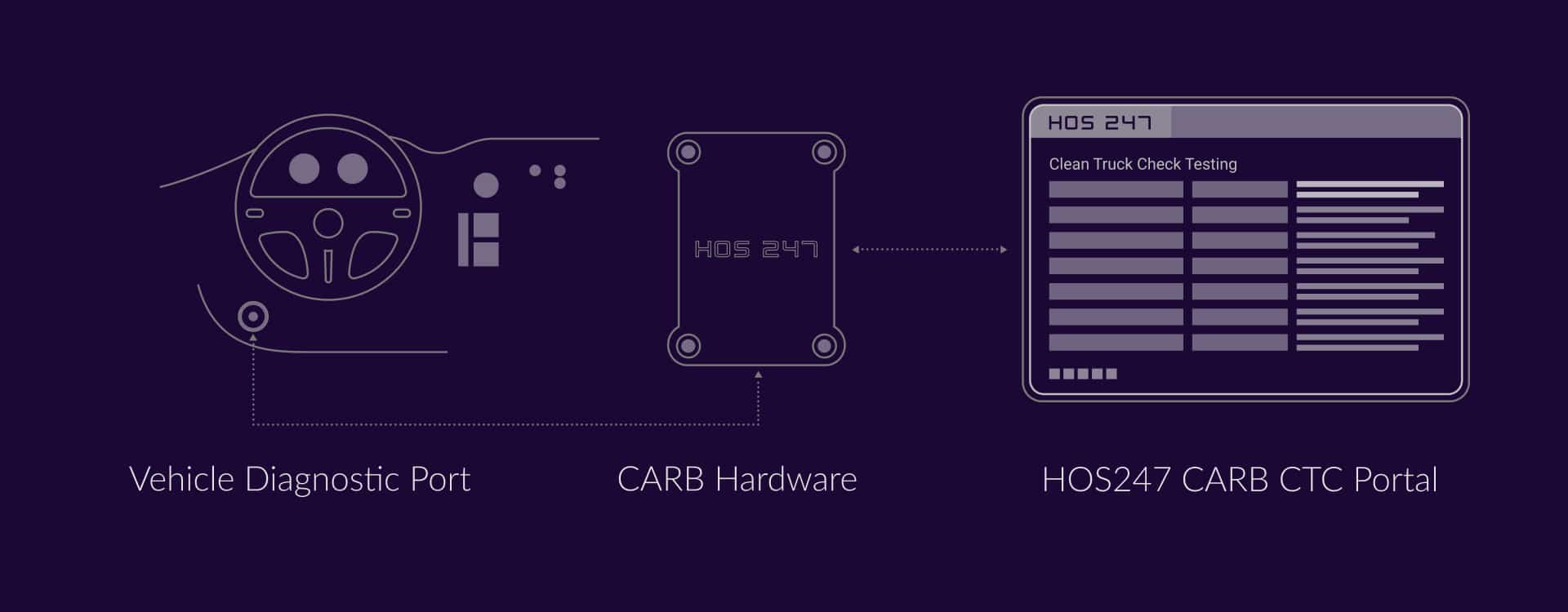
CARB-Certified Hardware
The foundation of the remote testing solution is the PT40 telematics device. HOS247’s PT40 is CARB-certified and is listed on the official CARB OBD Test Devices page. This full-featured telematics device manages emissions compliance while supporting broader fleet operations through several key features:
- Easy installation. The device connects directly to the truck’s diagnostic port and doesn’t require professional installation.
- Broad vehicle compatibility. The PT40 works across the full range of medium- and heavy-duty vehicles, supporting SAE J1939, J1979 (OBD-II), and J1979-2 (OBDonUDS) protocols through both 9-pin and 16-pin diagnostic ports.
- Built-in cellular connectivity. The device transmits test data over its own cellular connection, removing the need to pair with driver phones or local Wi-Fi.
- Selective data transmission. Test submissions include only the vehicle emissions data required by CARB, with no location or operational data transmitted.
- ELD and GPS fleet tracking functionality. Beyond emissions, the system supports electronic logging, real-time GPS fleet tracking, and IFTA calculations, all on a single device.
Integrated Web Portal
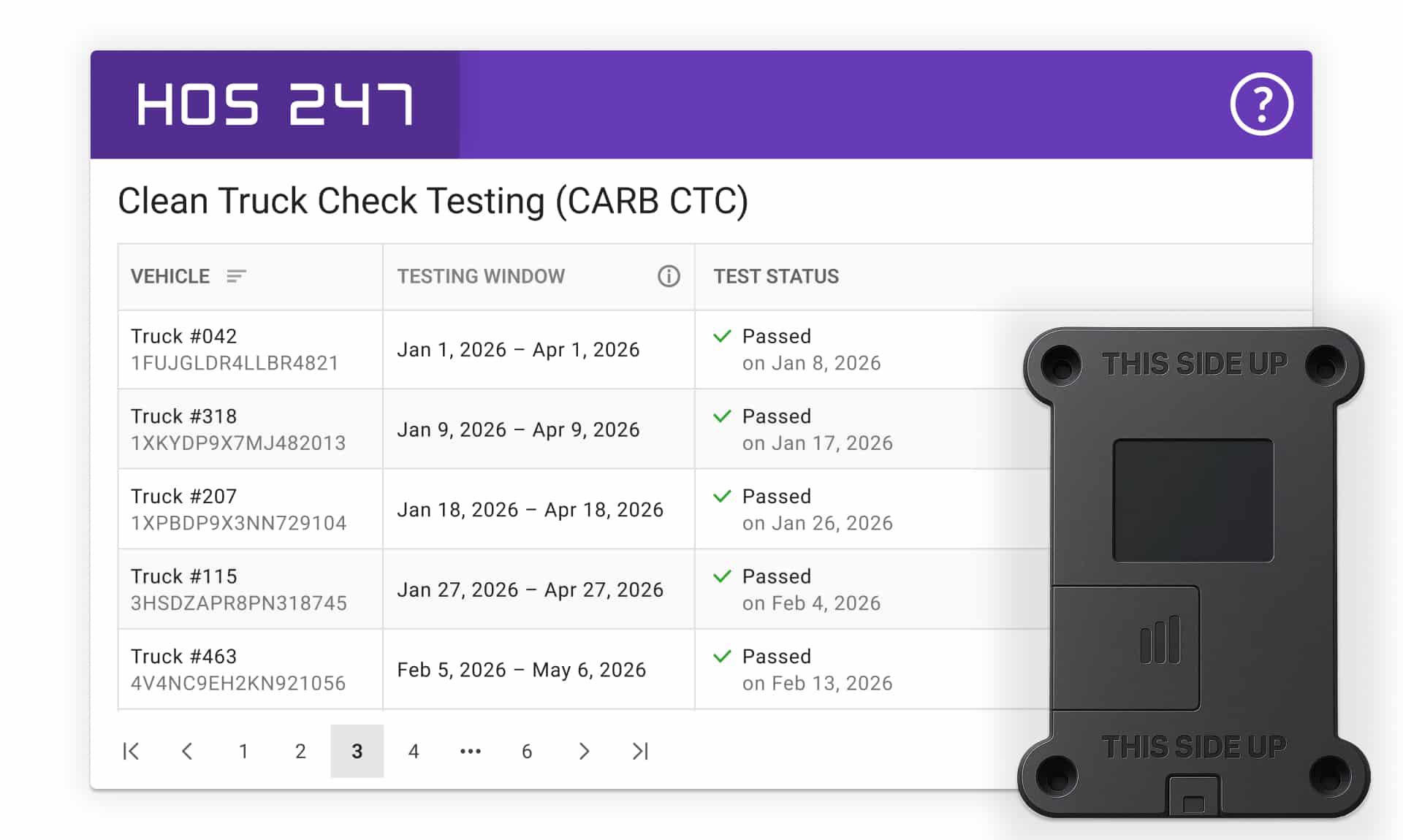
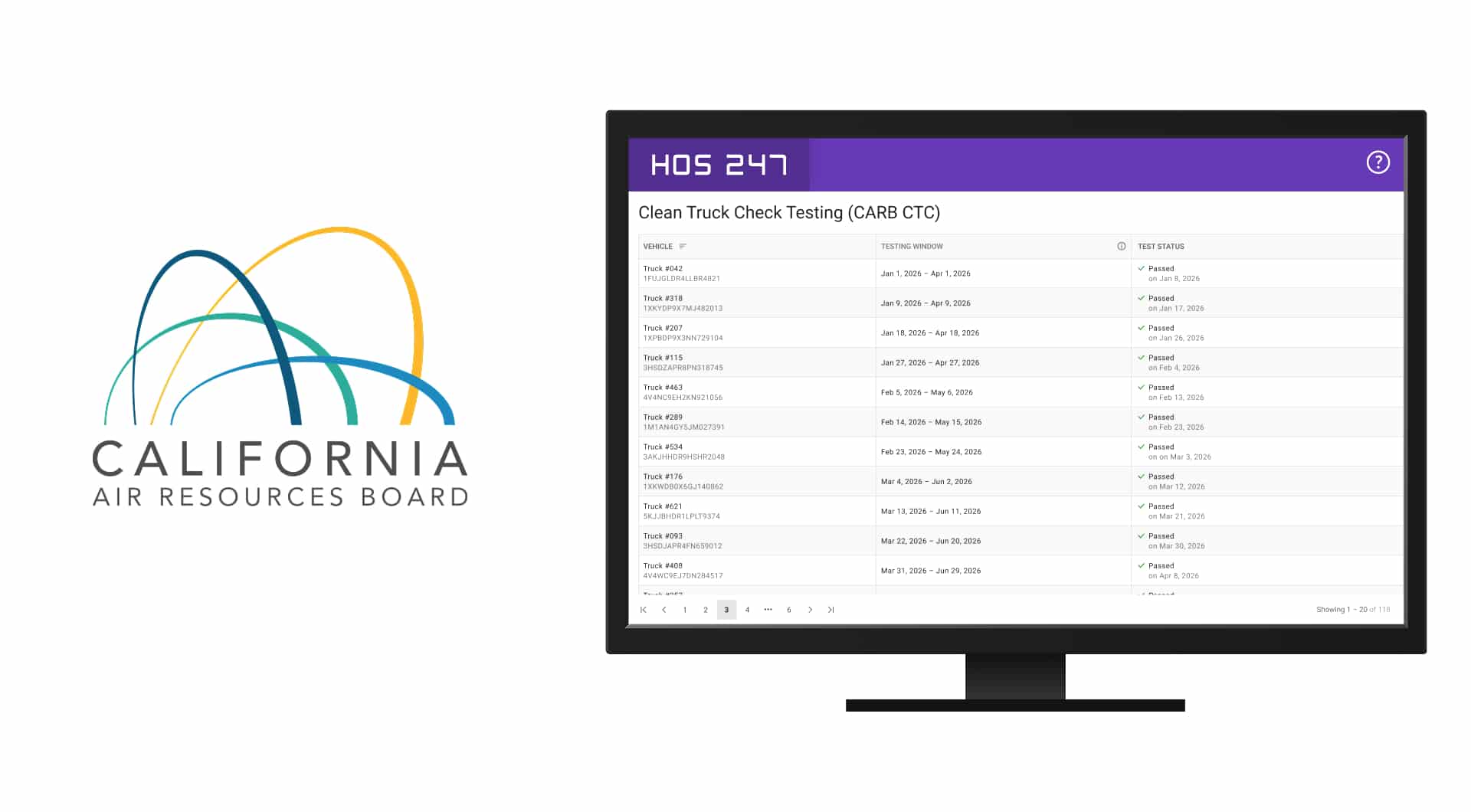
The HOS247 web portal allows fleet managers to schedule tests, view results, and track compliance status:
- Automated deadline calculation and test scheduling. The system automatically calculates each vehicle’s testing deadline based on state rules and runs tests within the compliance window. Fleet managers control how early within the official 90-day window automated tests should run.
- On-demand testing. Tests can also be run on demand at any time.
- Direct data submission. Test data is submitted directly to CARB after the test completion.
- Compliance window tracking. The portal shows each vehicle’s current pass or fail status and maintains a record of past test results.
Responsive Customer Support
Support is available seven days a week by phone, email, or contact form, in English and Spanish. Every request is handled by a support team with deep expertise across emissions testing, GPS fleet tracking, and electronic logging. Each case is handled from initial contact through resolution, with additional follow-up if needed.
With automated testing, direct CARB submission, and seven-day support, HOS247 gives fleets a simple way to stay compliant with CARB regulations, with benefits that only grow as testing requirements increase.
CARB Clean Truck Check Testing Requirements
The CTC program is built around three specific requirements: database registration, annual fee payments, and periodic testing. Every vehicle subject to the regulation must be registered in CARB’s Clean Truck Check-Vehicle Inspection System (CTC-VIS) online portal. Fleet owners must also pay an annual compliance fee for each vehicle.
Testing deadlines are determined by each vehicle’s registration. For vehicles registered in California, this deadline aligns with the annual Department of Motor Vehicle (DMV) registration renewal date. For vehicles registered outside California, or those with DMV-exempt plates, the deadline is determined by the last digit of the VIN. If a vehicle is subject to multiple tests per year, subsequent deadlines are calculated off the first compliance date.
Tests must be completed and submitted to CARB within a 90-day window prior to the deadline. Test results submitted earlier than this 90-day window are not accepted, requiring a second test.
Testing frequency depends on the vehicle category:
|
Vehicle Type or Status |
Testing Frequency |
|
Vehicles with 2013 and newer engines |
Twice per year through September 2027, then four times per year starting October 1, 2027 |
|
Vehicles with pre-2013 engines |
Twice per year |
|
Designated agricultural vehicles and California motorhomes |
Once per year |
Occasional out-of-state operators can apply for a single five-day short-term pass per calendar year instead of completing the full testing process.
Starting October 1, 2027, the testing frequency for vehicles with 2013 and newer engines increases to four times per year. For fleets relying on manual testing options, this change doubles the number of shop visits, the downtime per vehicle, and the appointment scheduling required to keep every truck compliant. Missing these dates carries strict consequences, as CARB enforces compliance through automated roadside monitoring, DMV registration blocks, and financial penalties.
HOS247’s Clean Truck Check Solution handles this increase with minimal effort. Fleet managers set the required number of tests per year, and the system tracks each truck’s deadlines and runs tests on schedule within the 90-day window automatically.
Clean Truck Check Testing Options
There are three ways to complete CARB clean truck check testing: remote, mobile, or in-shop.
- Remote testing. A CARB-certified telematics device stays plugged into the diagnostic port and runs tests during regular operation. This eliminates shop visits, visit scheduling, and driver involvement completely, making it the best option for modern fleets.
- Mobile testing. A credentialed tester travels to a fleet yard to perform emissions checks on site. This removes the trip to an outside facility, but still requires scheduling and causes vehicle downtime during the inspection.
- In-shop testing. Trucks drive to a certified testing facility for inspection. This option works for all vehicle types but creates significant downtime and requires logistical coordination.
Remote testing is the clear choice for fleets with vehicles with a 2013 or newer engine. It eliminates downtime, requires no scheduling, and needs no driver involvement — and unlike in-shop or mobile testing, retests carry no additional cost or coordination.
Once testing is complete, the certified device submits results directly to CARB. For in-person testing, the credentialed tester handles the submission.
Test Results and Compliance
After results are submitted to CARB, the agency evaluates the data and issues one of two outcomes:
- Pass. If the vehicle diagnostic scan or physical inspection reveals no emissions faults, CARB issues a compliance certificate. This certificate is available for download through the CTC-VIS portal and remains valid until the next testing deadline.
- Fail. If the vehicle does not pass, the operator must complete necessary repairs and submit retest results. Repairs and retests must be completed before the original deadline to avoid falling out of compliance.
Missing the compliance window carries operational and financial consequences that extend beyond the fines themselves.
Penalties for Missing or Failing CTC Tests
Missing CARB deadlines or ignoring emissions failures leads to financial penalties and operational disruptions. Because California tracks vehicles individually, each missed deadline or failed test counts as a separate violation, increasing the risk for fleets managing multiple trucks without a systematic approach.
CARB’s enforcement mechanisms can directly affect daily operations through several channels:
- Financial penalties. CARB issues fines for each vehicle that misses its testing window or continues to operate with active emissions faults.
- DMV registration holds. For California-registered vehicles, the state places a hold on registration renewals until tests are submitted and fees are paid, preventing the truck from operating legally.
- Port access restrictions. Marine terminals, rail yards, and other freight facilities must verify compliance before granting access. Non-compliant vehicles are denied entry, disrupting shipping schedules.
- Roadside monitoring. Automated roadside sensors flag high-emitting trucks between testing cycles. Flagged vehicles receive a notice giving the owner 30 days to submit a passing test to avoid fines.
- Broker restrictions. California requires freight brokers and contractors to work only with compliant carriers. Falling out of compliance means immediate removal from shipping contracts.
The indirect operational costs of non-compliance can be more damaging than the fines themselves. Continuously connected devices keep fleets compliant by automating the testing process even as the testing frequency increases.
The Increasing Value of Remote Clean Truck Check Testing
For fleets operating in California, Clean Truck Check emissions testing is already a mandatory part of operations, and the requirements are getting stricter.
On October 1, 2027, the testing frequency doubles to four times per year for vehicles with 2013 and newer engines. For fleets relying on in-shop or mobile testing, this means scheduling four shop visits or mobile inspections a year for every vehicle. Each visit takes a truck off the road, and at four times a year, the lost time adds up fast.
Remote testing scales with this increased frequency, with no impact on fleet operations. HOS247’s Remote Testing System uses continuously connected devices that run tests automatically while vehicles idle, with no shop visits or driver involvement.
As CARB clean truck check testing requirements increase, so does the value of remote testing solutions.

I’ve co-founded, built and managed several transportation-related businesses. Now, I’m a founder and CEO of HOS247 – an AI Transportation Platform for trucking companies, freight brokers and other logistics operations. We are transitioning old-style operations to technology-advanced logistics entities and help them to grow their businesses. ELDs (electronic logging devices), fleet tracking and management 2.0 combined with AI-powered dispatch tools.








User-friendly ELDs and accompanying apps are more important now than ever, as driver turnover continues to be a problem for trucking businesses. Difficult to navigate apps make drivers’ jobs more complicated. That is one more inconvenience that could make them
Imagine sitting in the cab with a DOT officer standing at your window, while your tablet screen is stuck on a spinning “Connecting…” wheel. In that high-pressure moment, the modern design of your application means nothing. The only thing that
Driving a commercial motor vehicle (CMV) across the United States involves more than just steering a wheel – it requires a deep understanding of the intricate road rules, particularly compliance with federal hours of service (HOS) regulations. In this article,