
What Is CARB Clean Truck Check?
Clean Truck Check (CTC) is a California program that requires heavy-duty vehicles to pass regular emissions tests. It is part of CARB’s effort to keep trucks and buses from releasing harmful pollutants as they age and accumulate miles on the road.
The program is relatively new. Roadside emissions monitoring began in 2023, and periodic testing has been mandatory since late 2024. Vehicles that are flagged for high emissions or miss a testing deadline can face penalties and registration holds.
Clean Truck Check applies to nearly all trucks and buses operating on California roads, including vehicles registered in other states.
Which Vehicles Are Subject to Clean Truck Check?
Clean Truck Check applies to nearly all vehicles with a gross vehicle weight rating (GVWR) over 14,000 pounds that operate on California’s public roads, covering both medium-duty and heavy-duty vehicles. This includes commercial trucks, buses, motorcoaches, shuttles, government vehicles, California-registered motorhomes, and even personal vehicles that meet the weight threshold. There is no fleet size minimum, which means that single-vehicle operations are also included.
Vehicles registered outside of California are subject to the same requirements if they operate in the state. Whether a truck is based in Texas, Oregon, or anywhere else, Clean Truck Check in California applies.
A small number of vehicle types are exempt: zero-emission vehicles, emergency vehicles, military tactical vehicles, historical vehicles, and motorhomes registered outside of California. What test a vehicle needs and how often it needs to be tested depends on the engine.
Testing Types by Vehicle Category
Clean Truck Check divides vehicles into categories based on engine type, and each category has its own testing requirements.
- Older diesel engines (2012 and earlier) are subject to a smoke opacity test and a visual inspection of emissions control equipment.
- Older alternative-fuel engines (2017 and earlier) are subject to a visual inspection only.
- Newer engines (2013+ diesel / 2018+ alternative fuel) are tested through an OBD scan of the engine’s diagnostic data.
For the first two categories, testing must be done in person, either at a facility or by a mobile tester. The third category is the largest and the only one eligible for remote testing with continuously connected devices. Starting in 2027, this category will need to be tested more frequently than the other two.
Clean Truck Check Requirements and Testing Schedule
Every vehicle subject to Clean Truck Check must be registered in CARB’s CTC Vehicle Inspection System (CTC-VIS). Registration comes with an annual compliance fee. Almost all vehicles subject to Clean Truck Check are required to complete testing twice a year. A limited number of exceptions, including agricultural vehicles and certain California-registered motorhomes, are currently on an annual testing schedule.
Test results must be submitted electronically to CARB by the vehicle’s compliance deadline, which can be done up to 90 days in advance. Vehicles that only occasionally operate in California can apply for a five-day short-term pass instead of completing the full testing process. The pass is available once per calendar year for each vehicle.
Starting in October 2027, the schedule changes for most vehicles covered by the program. Vehicles subject to OBD-based testing will be required to be tested four times a year instead of two, shifting fleets to every three months instead of every six. For fleets that rely on shop visits or on-site appointments, this doubles the downtime — unless that downtime is removed from the process entirely.
How Clean Truck Check Testing Works
Clean Truck Check testing requires CARB-certified devices, and results must be submitted directly to CARB. There are three ways to get it done.
- In-shop testing is the most traditional option. The vehicle goes to a certified testing facility, where a credentialed Clean Truck Check tester runs the appropriate test and submits the results. This works for all vehicle categories and requires taking the vehicle out of service.
- Mobile testing also works for all vehicle categories, just like in-shop testing. A credentialed tester arrives with a certified device, performs the test on-site, and submits the results. This removes the trip to a facility but still requires scheduling and vehicle downtime during the test.
- Remote testing is performed through a continuously connected device that stays plugged into the diagnostic port and runs tests as the vehicle operates normally. This eliminates vehicle downtime, appointment scheduling, and driver involvement. Tests can run automatically on a set schedule or on demand at any point during the submission window, and after completion, the results are sent to CARB.
Remote testing with continuously connected devices is available for every vehicle subject to OBD-based testing under CARB Clean Truck Check. This is the largest category in CARB’s CTC program, and the one moving to quarterly testing in 2027.
Clean Truck Check Certificates and Compliance
A CARB compliance certificate is issued once a vehicle passes its emissions test — provided the annual fee is paid and no enforcement actions are open. The certificate is valid until the next testing deadline and can be downloaded from the CTC-VIS account.
Vehicle owners can view current and historical test results through their CTC-VIS account. CARB also sends a monthly account summary listing the number of vehicles with an upcoming deadline and any open enforcement actions.
If the vehicle doesn’t pass by its deadline, it loses its compliant status under Clean Truck Check.
Non-Compliance Penalties and Enforcement
There are different ways to fall out of Clean Truck Check compliance. The impact starts with penalties from CARB but can extend well beyond the program itself.
Missed Deadlines and Compliance Fee Violations
The most common violations are missed testing deadlines and unpaid compliance fees. CARB can fine the vehicle owner and place a registration hold, which prevents the vehicle from being registered or renewed with the DMV until the issue is resolved.
Registration Holds and Operational Restrictions
But the consequences are not limited to CARB. Freight brokers in California are required to work only with compliant vehicles and keep records to prove it. Non-compliant vehicles can also be turned away from ports and railyards, where facilities must check compliance status before granting access. For fleets that depend on California freight, losing contracts and facility access can be more disruptive than the fines themselves.
Roadside Monitoring and NST Notices
Even vehicles that are meeting their testing deadlines can be flagged between test cycles. CARB uses roadside emissions monitoring devices to check vehicles on the road. A vehicle flagged as a potential high emitter receives a Notice to Submit to Testing (NST), which gives the owner 30 days to submit a passing test. If the vehicle needs repairs before it can pass, that window can get tight.
Tampering Violations and Fleet-Wide Impact
Tampering with emissions control systems is treated as a separate and more serious violation under California law. The penalties are well above those for missed deadlines or failed tests.
Each vehicle is tracked independently, and every missed deadline is its own violation. For a fleet of 50 trucks, that means managing a hundred testing deadlines a year, and twice as many in 2027. Continuously connected devices eliminate this problem entirely by running tests automatically on schedule, and that’s far from the only operational advantage they offer.
HOS247’s CARB Compliance Solution
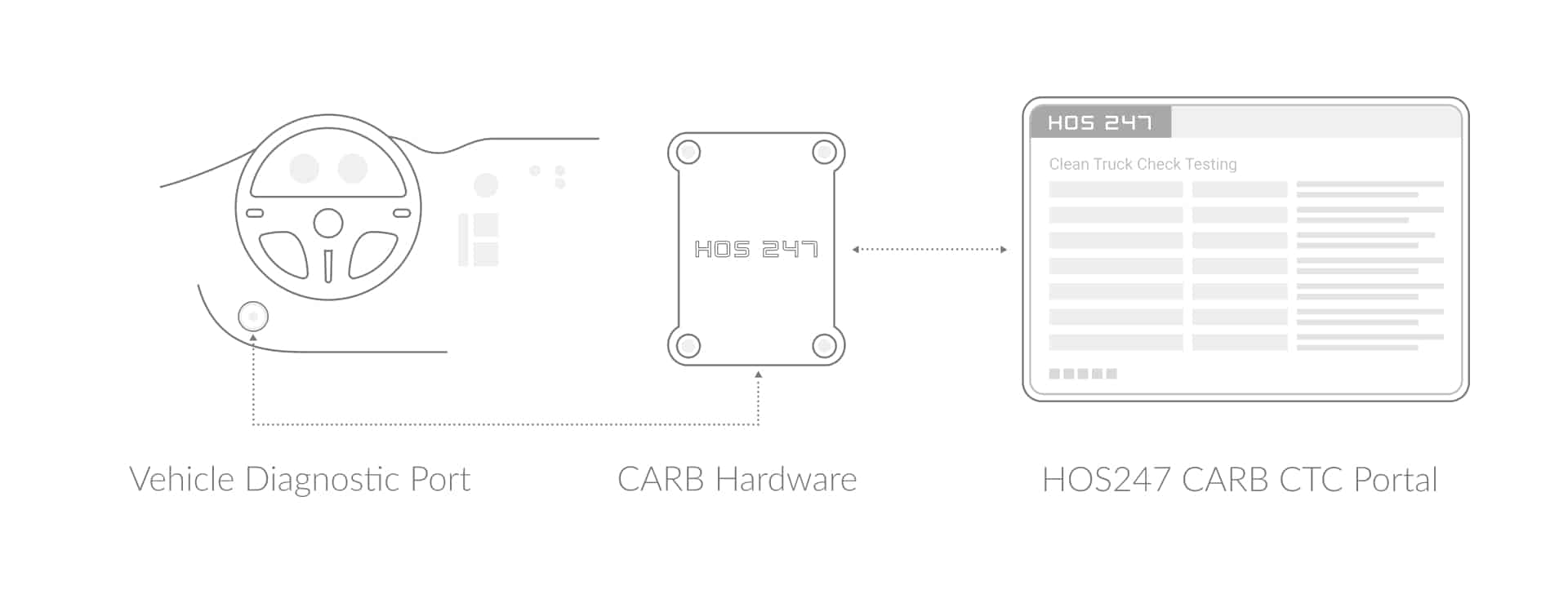
HOS247’s remote Clean Truck Check solution allows fleets to run emissions tests without taking trucks off the road. The system includes a CARB-certified telematics device and a portal fully integrated with the hardware, which simplifies the testing process and provides capabilities that extend beyond CARB compliance.
HOS247’s CARB-Certified Device
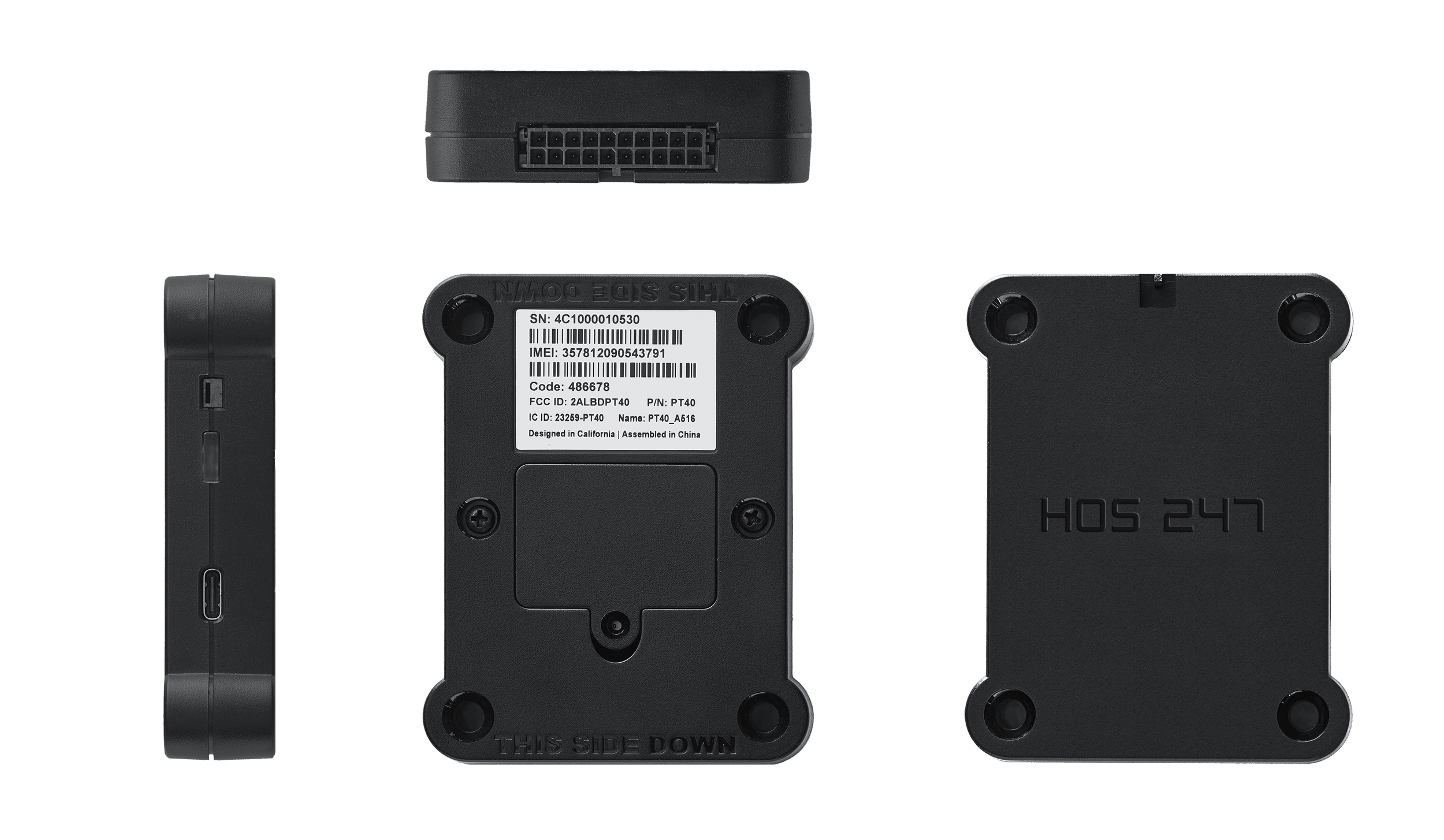
HOS247 offers PT40, a telematics device that is continuously connected to the vehicle’s diagnostic port and runs emissions tests while the vehicle operates. The device is certified by CARB and listed on the official CARB OBD Test Devices page.
- The PT40 works with both J1939 and OBD-II vehicles, covering all OBD-eligible fleets regardless of engine interface.
- Installation is plug-and-play: the hardware connects directly to the diagnostic port with no technician required.
- The device has built-in cellular connectivity and transmits test data to CARB without a separate internet connection.
- Only the vehicle emissions data required by CARB is included in test submissions. No location data is sent.
HOS247’s Clean Truck Check Portal
The HOS247 portal allows fleet managers to schedule tests, view results, and track compliance status.
- Each vehicle can be set to run tests automatically based on its compliance schedule.
- Tests can also be triggered on demand at any point during the submission window.
- Test data is submitted directly to CARB, so no manual reporting is required.
- A historical record of past tests and results is available in the portal.
Integrated ELD and GPS Fleet Tracking
The PT40 is a full-featured telematics device whose functionality extends beyond Clean Truck Check testing. HOS247’s CARB compliance solution includes GPS fleet tracking, giving fleet managers visibility into real-time vehicle location.
Electronic logging is another feature available on the PT40. Fleets that need ELD can easily add it to their plan to get hours-of-service tracking, log management, and IFTA reporting.
All three functions run on one device and are managed through HOS247’s web portal, consolidating compliance, fleet tracking, and electronic logging in a single system.
HOS247’s CARB Compliance Solution comes with seven-day support by phone, email, or contact form, in English and Spanish. Every request is handled by a support team with deep expertise across emissions testing, GPS tracking, and electronic logging, from initial contact through resolution.
Remote testing with HOS247 keeps fleets compliant without the scheduling, downtime, or coordination of manual testing. As testing frequency increases, each of those advantages becomes even more valuable. The included GPS fleet tracking and available ELD capability extend the solution into daily fleet operations, adding value well beyond emissions testing.
Remote Testing — The Future of Clean Truck Check Compliance
California has been regulating heavy-duty vehicle emissions for decades. Earlier programs like the Heavy-Duty Vehicle Inspection Program and the Periodic Smoke Inspection Program relied on roadside spot checks and fleet self-testing.
Clean Truck Check replaced both with a single mandatory program for nearly every vehicle over 14,000 pounds GVWR on California roads. More than a dozen states have already adopted California’s heavy-duty emissions regulations, and that number continues to grow. The direction has been consistent: broader coverage, stricter standards, more frequent testing.
The structure of the program already reflects where things are headed. Older vehicles face lighter testing — visual inspections and opacity checks — in line with the expectation that those engines are gradually being replaced. Newer, OBD-equipped vehicles make up the largest category and are the focus of increasing requirements, starting with the move to quarterly testing in 2027.
As testing requirements increase, continuously connected devices are becoming a more valuable tool for fleet compliance. HOS247’s remote Clean Truck Check solution eliminates the need to take trucks off the road, saving fleets time and resources. With more vehicles covered and more frequent testing ahead, that value will only continue to grow.

I’ve co-founded, built and managed several transportation-related businesses. Now, I’m a founder and CEO of HOS247 – an AI Transportation Platform for trucking companies, freight brokers and other logistics operations. We are transitioning old-style operations to technology-advanced logistics entities and help them to grow their businesses. ELDs (electronic logging devices), fleet tracking and management 2.0 combined with AI-powered dispatch tools.









The reality of the road is harsh. A cheap DOT electronic log app might save you $5 a month on a subscription, but that savings evaporates instantly when the system crashes during a roadside inspection. A single form and manner
Managing assets effectively is key to running a successful trucking operation. With vehicles spread out across the country, companies need reliable tools to track their fleet, stay in control, and make smart decisions. GPS fleet tracking systems have changed the
The federal mandate for electronic logging devices for trucks is now in full force. This new requirement became law in February 2016 with a mandatory implementation date of December 2017. An exemption was originally made for AORBD (Automatic On-Board Recording