
What Is a Fleet Management System?
Fleet management refers to the processes that help oversee trucking operations and handle relevant data regarding vehicles and other assets. Fleet management systems simplify these tasks to reduce costs, keep the fleet in shape and stay on top of compliance requirements.
Core Functions of a Fleet Management System
Some of the actions required to keep a fleet running efficiently and that can be automated are:
- Route planning and dispatch coordination. Match available drivers and vehicles with upcoming loads to reduce unnecessary mileage and scheduling conflicts.
- Vehicle maintenance. Track service intervals and schedule preventive work to keep trucks in good condition.
- Fuel consumption and cost monitoring. Review fuel use and idle time to identify unnecessary expenses.
- Operational improvements. Identify recurring delays, extended downtime, and other problems that reduce profitability.
- Driver management. Review available driving hours, inspection reports, and safety concerns to support drivers throughout their workday.
- Waste reduction. Reduce duplicate administrative work and avoidable trips that consume time and resources.
- Asset utilization. Identify underused vehicles and make better use of available equipment.
In sum, if your company depends on commercial vehicles, you are dealing with fleet management. While it might seem challenging to handle everything, a web based fleet management system can be of great help.
How Fleet Management Systems Collect and Organize Data
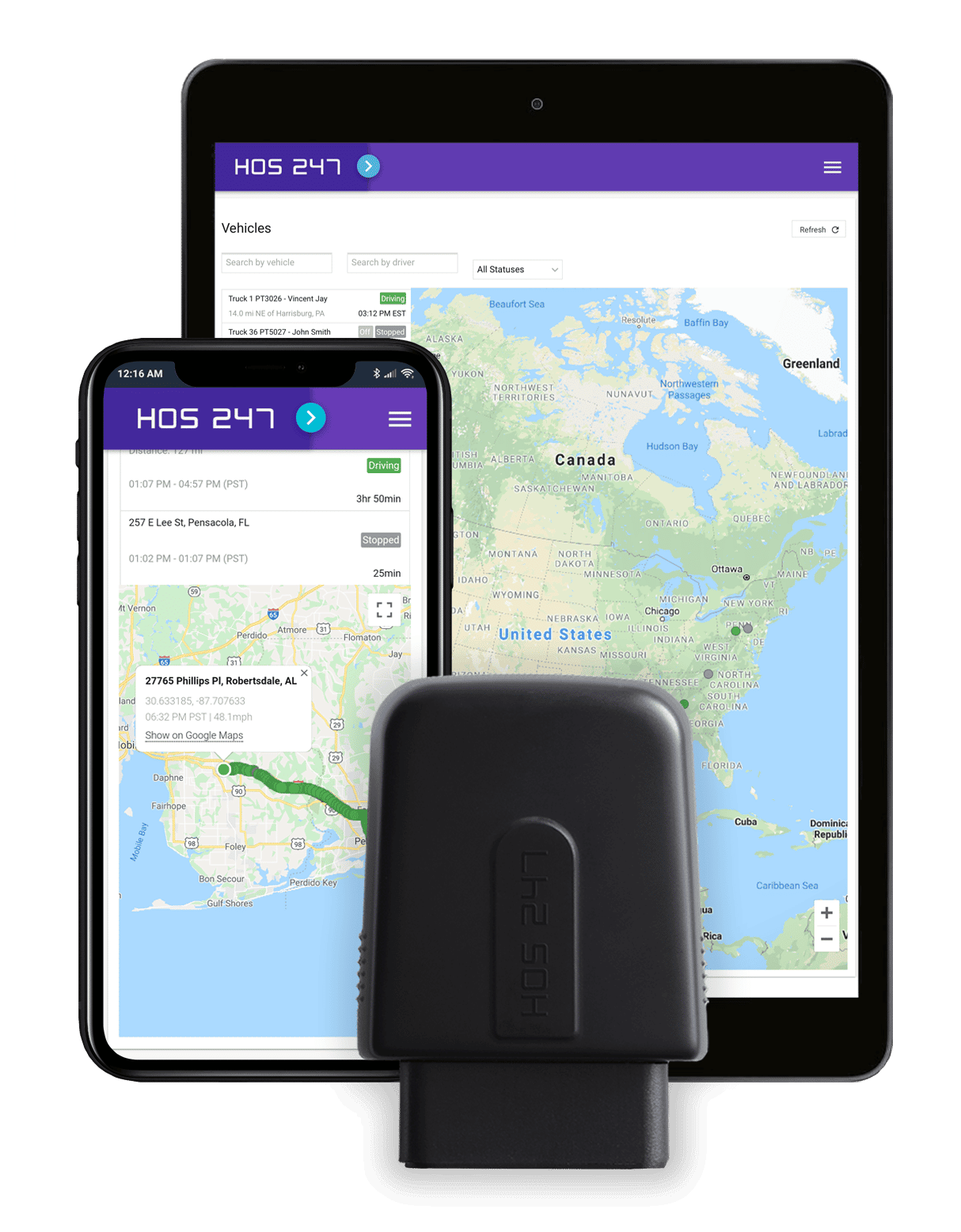
These platforms bring information from different parts of the business into one place. Connected hardware collects vehicle data through the diagnostic port, while a driver’s mobile app supports tasks such as recording duty status and completing inspection reports. Depending on the system’s features, dispatchers and managers can review vehicle locations, driver availability, and maintenance information through an online dashboard.
Cloud-based software stores this information online, allowing authorized users to access it from an internet-connected computer, phone, or tablet. For example, a manager can review a reported vehicle defect while away from the office and arrange service before the truck’s next assignment. Drivers and office staff can work from the same updated records, reducing the need for repeated calls and messages.
Moving from spreadsheets and paper records to an automated platform reduces the time spent entering, copying, and checking information. Instead of collecting mileage figures or searching through inspection forms, staff can review organized records and focus on issues that need attention. This lowers daily administrative overhead and makes it easier to manage more vehicles without increasing paperwork at the same pace.

Advantages of Using an Online Fleet Management System
The returns for investing in a cloud fleet management system make it worthwhile. Amongst the multitude of benefits that help trucking businesses grow are.
Compliance, Safety, and Vehicle Management
- Simplified regulatory compliance. Drivers must ensure that they comply with regulatory laws. Fleet management technology can assist with electronic logs, log auditing, electronic driver vehicle inspection reports (eDVIR), tax reports, and more. Mileage calculations by jurisdiction simplify International Fuel Tax Agreement (IFTA) reporting. Compatible platforms can also support California Air Resources Board (CARB) Clean Truck Check emissions testing and submissions through certified telematics devices.
- Driver safety. Keeping your drivers safe must be a priority. Fleet management solutions assist with real-time locations, driving behavior, and vehicle conditions to help reduce the risk of accidents and mechanical issues.
- Easier maintenance. Keeping track of maintenance needs for each vehicle in the fleet can be complex and time-consuming. Fleet management system features usually include preventative maintenance scheduling and fault code detection to make this task easier and keep vehicles running smoothly. Diagnostic trouble codes (DTCs) help managers identify issues that need further diagnosis, while service reminders help them schedule routine maintenance between trips.
- Protecting carrier safety performance. Reviewing logbook issues and vehicle defects helps managers address problems before they result in violations. The Federal Motor Carrier Safety Administration’s (FMCSA) Compliance, Safety, Accountability (CSA) program uses inspection, violation, and crash data to evaluate carrier performance. Fleet software can support efforts to reduce preventable violations, but it does not guarantee improved safety percentiles.
Productivity, Customer Service, and Cost Control
- Increased productivity. Fleet managers can review drivers’ hours of service (HOS) and locations. Platforms with traffic information also help teams account for road delays. As a result, dispatch is more efficient. Operational and historical data are available to help supervisors find opportunities to minimize risks and increase productivity.
- Improved customer service. Tracking assets and driver statuses allows managers to inform clients more accurately about the status of their orders. Access to vehicle locations helps teams provide updated arrival estimates without repeatedly calling drivers for updates.
- Reduced costs. One of the best things about fleet management platforms is that it decreases transportation complexities, which helps cut costs. Idling monitoring, better routing, and proper vehicle maintenance mean less expenditure on fuel and repairs. Additionally, location and trip records can help identify unauthorized use of the vehicle.
You can get these benefits from a dependable fleet management solution. A quick comparison of features and providers’ ratings on app distribution platforms will go a long way to make sure you choose the right system for your trucking business. Once the system is in use, reviewing patterns in idle time, repairs, and vehicle availability helps managers decide where to focus their efforts and measure progress.
HOS247 Offers an All-In-One Web Based Fleet Management System
HOS247 is here to help. We are a one-stop solution for truckers that helps keep you compliant with federal laws and regulations and boost performance. Our fleet management system features include:
- ELD. Electronic logging devices are mandatory for most commercial drivers who must keep records of duty status. HOS247’s electronic logbook is designed to comply with the FMCSA requirements with minimal effort.
- IFTA mileage calculations. Reduce the administrative burden of manually calculating mileage per jurisdiction and the risk of human error, which could result in inaccurate tax reports.
- GPS fleet tracking. Our 4G GPS trackers provide real-time visibility of every truck in the fleet. Moreover, location and movement records help managers identify vehicle misuse and respond to suspected theft. It can also help recover stolen assets.
- Vehicle maintenance. Ensure proper vehicle upkeep and care to minimize issues on the road with preventative maintenance reminders. It also helps extend your vehicles’ useful lives.
- Fault code detection. Knowing about issues that can affect vehicle performance allows fleet managers to resolve them before they become a significant problem, saving time and money. HOS247’s diagnostic trouble code information helps managers identify problems that require attention, supporting driver safety and reducing the risk of downtime.
- Automated idle tracking. Idling leads to fuel wastage. Monitoring idling time is a way for fleet managers to identify this problem and help drivers keep it to a minimum.
- Remote CARB Clean Truck Check testing. HOS247 supports automated emissions testing and submissions using a CARB-certified device. Connected to the vehicle’s diagnostic port, the hardware reads onboard diagnostics (OBD) emissions data and submits test results to CARB through a cellular connection. Scheduled tests take place during normal vehicle operation, helping fleets avoid trips to testing facilities, time off the road, and fees for individual shop tests.
These features help truckers comply with federal laws and utilize resources efficiently to increase profitability.
Benefits of HOS247 Services
At HOS247, we work hard to give our clients reliable services that contribute to their business. This work ethic is why we stand out from other providers. In addition to compliance and driver safety, our services come with the following benefits:
- Premium customer support. We have an efficient and responsive customer support team for your assistance. You can call any day of the week and we will help you troubleshoot in English, Spanish, Polish, or Russian.
- No contracts. With HOS247, customers are not tied to contracts. Our dependable service is the reason our clients decide to stay with us. If you don’t want to continue our service for any reason, you are free to do so without worrying about fines or penalties.
- Flexible plans. You can scale your plan up or down to accommodate the business’s needs. Monthly and annual subscription options let carriers choose a payment schedule that suits their budget.
- Two-week trial with hassle-free return. You can try out our services for two weeks to find out if we meet their fleet management system requirements. If you are not convinced, you’ll get a full hassle-free refund.
- Bring your own device. The HOS247 electronic logbook app works on compatible Android and iOS smartphones and tablets. Drivers can use an existing device, helping carriers avoid the cost of purchasing or renting dedicated tablets for electronic logging.
- Reliability and efficiency. Our hardware is durable, our software is dependable and our after-sale services are top-rated. HOS247 is a strategic partner for transportation businesses.
Managing electronic logging, GPS tracking, and remote emissions testing through one provider reduces the need to maintain separate systems. For compatible vehicles, a shared hardware setup can also reduce duplicate equipment and simplify support as the fleet adds services.

Who Needs ELDs According to the FMCSA?
Before choosing a fleet management system, carriers should determine which drivers need electronic logging. The FMCSA makes it mandatory for most drivers who must keep records of duty status while operating commercial motor vehicles in interstate commerce to use an FMCSA-registered ELD. This includes drivers based in Mexico or Canada when operating in the United States. However, there are a few cases where the FMCSA allows exemption from the ELD rule. In the following cases, drivers can manually record their hours of service:
- Pre-2000 vehicles. Vehicles with engines predating model year 2000 qualify for the exception, including newer trucks fitted with qualifying older engines. The vehicle identification number (VIN) generally establishes the vehicle’s model year, but carriers should retain documentation of engine changes when the engine and vehicle model years differ.
- Driveaway-towaway operations. If the truck is the product being delivered.
- 8-day RODS. Drivers who need to keep RODS for no more than eight days in any rolling 30-day period can use paper logs. The eight days do not have to be consecutive.
- Cases of ELD malfunction. Drivers experiencing issues with their elogs must notify their motor carrier in writing within 24 hours. If the malfunction prevents accurate recording, drivers must use compliant backup records and reconstruct the current day and previous seven days unless those records are already available. Carriers must repair or replace the device within eight days of discovering the problem or receiving the driver’s notification, whichever occurs first. Continuing with paper logs beyond the permitted period requires an FMCSA extension. This is a temporary backup procedure rather than an ongoing exemption.
Additionally, qualifying short-haul drivers — operators who only drive within 150 air-miles from their normal work reporting location — are exempt from keeping RODS since they use time cards instead. Under the standard short-haul exception, drivers must also return to that location and be released from work within 14 consecutive hours. Staying within the radius alone is not enough to qualify.
Employers must retain accurate short-haul time records for at least six months. These records must show when each driver reports for duty, when the driver is released, and the total hours on duty each day. For drivers used for the first time or intermittently, records must also include total on-duty time for the preceding seven days.
Checking these criteria helps carriers avoid purchasing electronic logging equipment for drivers who do not need it. It also helps identify when a change in routes or schedules creates a logging requirement, so the fleet can adjust before a compliance issue occurs.
Penalties, Fines, and Environmental Non-Compliance Costs
Missed compliance tasks can cost more than the time needed to correct them. In addition to fines, carriers may face delayed loads, unavailable vehicles, and missed revenue while problems are resolved. Understanding the potential consequences helps managers prioritize log reviews, maintenance, and testing deadlines.
- Federal recordkeeping penalties. Under 49 CFR Part 386, Appendix B, failing to prepare or maintain required records — or keeping incomplete, inaccurate, or false records—can result in civil penalties of up to $1,584 for each day the violation continues, up to $15,846. These are maximum amounts, rather than a standard fine for every paperwork mistake.
- Knowing falsification of records. Knowingly falsifying required records to misrepresent a violation beyond a reporting or recordkeeping issue can carry a maximum civil penalty of $15,846. For example, changing a log to conceal excess driving time can create a separate enforcement issue from the underlying hours-of-service violation.
- California emissions penalties. Clean Truck Check applies to most diesel and alternative-fuel vehicles with a gross vehicle weight rating (GVWR) over 14,000 pounds operating on California public roads, including vehicles registered elsewhere. CARB identifies potential civil penalties of $1,000 to $10,000 per day per vehicle under California Health and Safety Code Section 42402. The amount assessed depends on the circumstances; the maximum is not an automatic daily charge.
- Registration and freight access restrictions. California DMV registration holds prevent non-compliant vehicles from completing registration or renewal until outstanding Clean Truck Check requirements are met. Non-compliance can also lead to denied access at freight facilities, disrupting scheduled pickups and deliveries.
Regular reviews of driver logs, unresolved defects, and emissions deadlines help carriers address issues before they interrupt operations. A fleet management system supports this work by making records easier to review and follow up on. Combined with timely corrective action, that visibility helps reduce exposure to fines, out-of-service orders, and broader enforcement actions that can threaten the business’s ability to operate.
How to Select the Right Fleet Management System
The right platform should fit the fleet’s daily work and budget. Before comparing providers, list the tasks that take the most time or create recurring expenses. Then use the following checklist to evaluate whether a system can address those needs:
- Assess fleet size, vehicles, and routes. Identify how many tractors, trailers, and light trucks need monitoring and which functions each requires. A trailer may need a separate tracking device, while a tractor may need electronic logging and engine diagnostics. Consider interstate routes, local operations, and trips into California when choosing compliance features.
- Calculate the total cost. Request a written breakdown of hardware, installation, activation, monthly subscriptions, and optional services. Include replacement equipment and any dedicated mobile devices in the comparison. Check cancellation terms and whether changing the vehicle count affects pricing. A low advertised monthly fee may not reflect the full cost of using the system.
- Test everyday usability. Have drivers try common tasks, such as changing duty status, reviewing logs, completing inspection reports, and preparing for a roadside inspection. Office staff should also test vehicle searches, maintenance records, and report downloads. Use a trial period to see whether the system makes these tasks easier during an actual workday.
- Verify registration and compatibility. Check the specific ELD model against FMCSA’s current registered and revoked device lists. FMCSA registration is based on provider self-certification, rather than agency product approval. For remote Clean Truck Check testing, confirm that the hardware is CARB-certified and compatible with the vehicle’s engine and diagnostic connection.
- Evaluate technical support. Confirm support hours, available languages, and how the provider handles dropped calls or unresolved requests. Ask what assistance is available during installation and equipment replacement. Responsive help matters when a driver needs to resolve a problem before returning to work.
A practical trial makes the comparison more useful than a feature list alone. Testing the system with representative vehicles, drivers, and routes helps reveal whether the hardware, software, and support meet the fleet’s requirements before a wider rollout.
Frequently Asked Questions About Fleet Management Systems

I’ve co-founded, built and managed several transportation-related businesses. Now, I’m a founder and CEO of HOS247 – an AI Transportation Platform for trucking companies, freight brokers and other logistics operations. We are transitioning old-style operations to technology-advanced logistics entities and help them to grow their businesses. ELDs (electronic logging devices), fleet tracking and management 2.0 combined with AI-powered dispatch tools.









Truck drivers and fleet managers have found a trustworthy digital truck logbook provider in HOS247. Our team has assembled a solution that drivers can rely on; it is approved by the FMCSA and keeps accurate HOS logs with minimal effort
Fleet tracking devices have become essential tools for modern trucking operations, transforming how businesses manage their vehicles, drivers, and overall efficiency. These sophisticated systems provide real-time visibility into fleet operations while helping companies reduce costs, improve safety, and maintain regulatory

In the commercial trucking industry, managing hours of service compliance is a constant operational challenge. Navigating complex Department of Transportation (DOT) regulations without the right systems often leads to accidental form-and-manner errors, unexpected roadside citations, and costly out-of-service orders. To