
Types of GPS Tracking Devices for Semi Trucks
Choosing the right hardware is the first step in building a reliable monitoring system. In the heavy-duty trucking industry, “one size fits all” does not apply. The device you choose depends on how much data you need to pull from the engine, how permanent you want the installation to be, and whether you are tracking the tractor or the trailer.

OBD-II and Diagnostic Port Trackers (Plug-and-Play)
These are the most popular choice for modern fleets due to their “plug-and-play” nature. Instead of cutting wires, these devices slide directly into the vehicle’s diagnostic port. While consumer vehicles use a standard OBD-II port, heavy-duty semi trucks require specialized connectors.
- 9-pin (J1939) and 6-pin (J1708). Most Class 7 and 8 trucks use these circular Deutsch connectors. A high-quality tracker will offer adapters for both to ensure compatibility across different truck makes and ages.
- Installation. This is the fastest method. A driver or manager can perform the installation in roughly 30 seconds.
- Pros. It pulls deep engine data (fuel sync, fault codes) and is easily moved from one truck to another if you rotate your fleet.
Hardwired GPS Trackers
For fleet owners who want a “set it and forget it” solution that stays out of the driver’s way, hardwired trackers are the industry standard. These units are connected directly to the truck’s internal wiring (power, ground, and ignition).
- Placement. Because they don’t occupy the diagnostic port, they can be tucked deep behind the dashboard. This makes them virtually tamper-proof and hidden from view.
- Installation. This requires more “elbow grease.” It typically involves a professional installer or a skilled mechanic and takes between 30 to 60 minutes.
- Pros. Higher security: the device cannot simply be “unplugged” to go off the radar.
Battery-Powered (Asset) Trackers
While tractors have a constant power source, trailers and specialized equipment often do not. Battery-powered trackers are self-contained units designed for these specific assets.
- Portability. These are often magnetic or bolt-on. They are ideal for tracking flatbeds, dry vans, or construction equipment.
- Maintenance. Since they aren’t drawing power from the engine, they require regular charging or battery replacements. Many modern versions use high-capacity batteries that can last months or even years depending on the “ping” frequency.
- Pros. Extremely versatile; can be hidden inside cargo or under a trailer chassis.
Choosing between a plug-and-play unit and a hardwired installation comes down to your priority: speed or security. For carriers that need to get compliant with ELD mandates quickly, the diagnostic port trackers offer the path of least resistance. However, for those focused on high-value asset security and preventing unauthorized device removal, the hardwired route provides the most peace of mind. By matching the hardware to your specific operational needs, you ensure your fleet remains visible without adding unnecessary complexity to your maintenance schedule.
Installation Options and Requirements
The efficiency of a GPS fleet tracking system is only as good as its installation. A loose connection or a poorly placed antenna can lead to data gaps that affect your compliance and bottom line. When choosing between a DIY plug-and-play setup and a professional hardwired installation, you must consider your vehicle type, your security needs, and your available downtime.
OBD-II / J1939 Installation: The 30-Second Setup
For most trucks manufactured after 2000, the diagnostic port installation is the standard. This is a non-invasive process that requires no special tools.
Step-by-Step Process for Heavy-Duty Trucks
- Locate the port. In most semi trucks, the 9-pin (J1939) or 6-pin (J1708) port is located under the dashboard on the driver’s side, often near the left kick panel or steering column.
- Align and twist. Align the pins of the GPS tracker with the port. Push firmly and twist the locking ring clockwise until it clicks into place.
- Secure the device. Use a zip tie to ensure the tracker doesn’t vibrate loose over thousands of miles of highway driving.
- Verification. Start the engine. Most HOS247 devices feature LED indicators; a solid green or blue light usually confirms that the device is receiving power and has established a GPS lock.
When to Choose Professional Hardwired Installation
While plug-and-play is convenient, professional hardwired installation is often the better choice for long-term security. These devices are spliced directly into the truck’s ignition and power wires.
You should choose professional installation if:
- Anti-tampering is a priority. You want to prevent accidental or intentional unplugging of the unit.
- Port availability. You need to keep the diagnostic port open for other tools or mechanic scanners.
- Discreet placement. You want the tracker hidden deep behind the dashboard to assist in theft recovery.
Compatibility and Requirements
Before purchasing, verify that your equipment meets these basic industry standards:
- Manufacturing date. Most electronic trackers require the truck to be manufactured after 2000 to support the digital data protocols needed for fuel and engine monitoring.
- Port types. Ensure your provider offers the correct adapter. While newer trucks use the green 9-pin (Type 2) connector for faster data speeds, older models may use the black 9-pin (Type 1) or the 6-pin J1708.
- Extension cables and adapters. If your diagnostic port is in an awkward location where the tracker might interfere with the driver’s legs, use a Y-cable. This allows you to hide the tracker behind the dash while still leaving an open “dummy” port for mechanics to use.
The right installation strategy is one that fits your maintenance schedule without causing a bottleneck. While the 30-second plug-and-play method is ideal for quick deployments, don’t overlook the value of a professional hardwired setup if you operate in high-risk areas where theft is a concern. Regardless of which path you choose, using extension cables and proper securing techniques will prevent the “connection lost” alerts that can lead to headaches during a roadside inspection. A clean installation is the first step toward a worry-free monitoring system.
Must-Have Features of a Semi Truck Tracking Device
The GPS fleet tracking device receives signals from satellites, determines precise positioning, and transmits this data to a centralized fleet manager portal. Based on the information received from the tracker, a detailed truck location history is built on the map. This core function records the exact time of every start and stop, while also determining the average speed across specific route sections to help identify bottlenecks.
However, location and motion tracking are no longer the only functions of modern GPS trackers for semi trucks. To be truly viable in today’s market, trackers must act as multi-sensory tools. They can be equipped with temperature sensors for reefer monitoring and accelerometers that respond to sudden changes in the semi truck’s position or cargo state. When you utilize the full spectrum of these functions, you create an integrated monitoring system that offers:
- Speed control. Monitoring when a driver exceeds the maximum allowable speed.
- Driving quality ratings. Monitoring for jolts, jerks, hard braking, and impacts (essential for high-value or fragile freight).
- Cold chain integrity. Alerts when the trailer temperature fluctuates outside a specified range.
- Fuel security. Real-time monitoring of fuel levels to detect unauthorized discharges or “skimming” at the pump.
- Cargo protection. Sensors for the opening and closing of cargo doors.
- Asset identification. Automatic identification of trailer equipment and driver ID verification to prevent unauthorized use.
HOS247 provides easy access to your fleet around the clock and from anywhere. Your trucks become a safe, economical and high-quality business tool.

Minimum Details — Maximum Efficiency
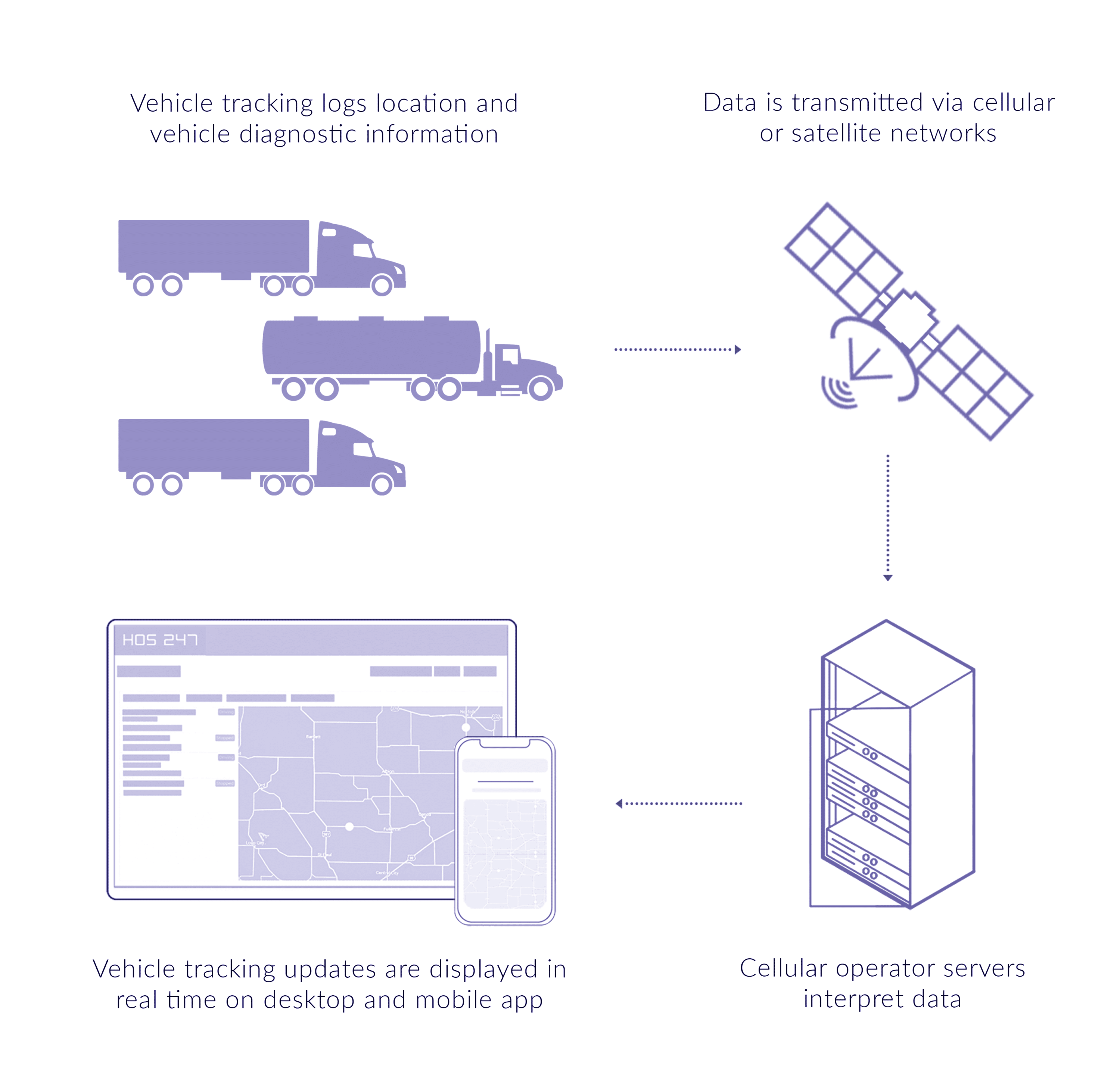
GPS monitoring system usually consists of three key components that provide an integrated approach:
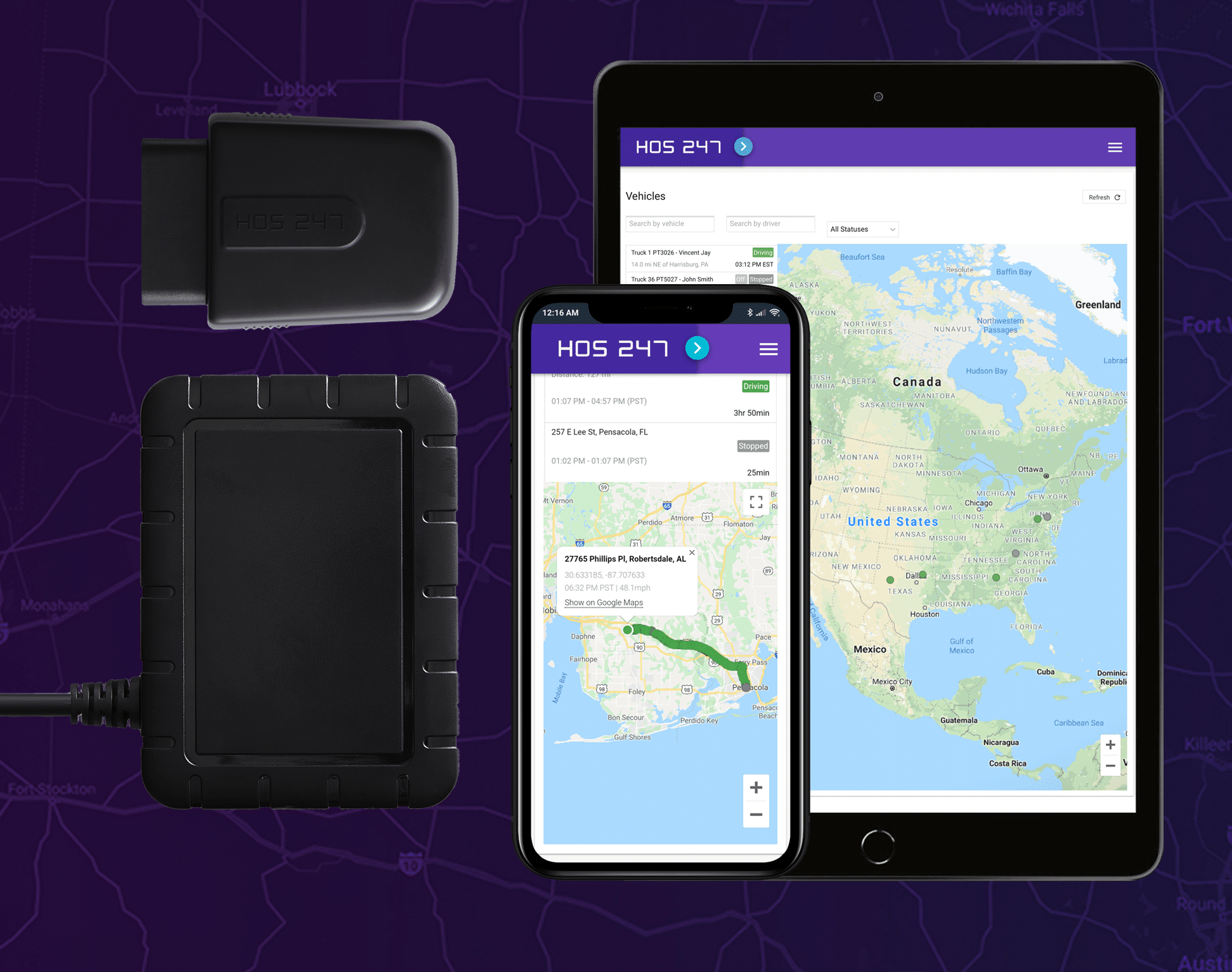
- The hardware. The “Black Box” collecting engine and satellite data.
- The server. A secure cloud-based brain that stores and analyzes the data.
- The user interface. The easy-to-read dashboard (web or mobile) that converts data into maps, charts, and graphs.
GPS fleet tracking devices collect and send vehicle and driver data to a central server that is then displayed in an easy-to-read form, including interactive maps, charts, and graphs that allow you to make decisions in seconds rather than digging through spreadsheets.
Increase Your Business Competitiveness With GPS Devices
The implementation of GPS trackers for semi trucks brings tangible benefits. Fuel consumption is reduced. Empty/dead miles are decreased. Freights are delivered faster at their destination, and delivery time is reduced. In addition to the financial gains, fleet monitoring benefits include safety on the roads, protection against theft and convenient reporting.
These competitive advantages include:
- Real-time theft recovery. Live location information allows managers to track a “breadcrumb” trail for law enforcement.
- Customer service improvements. Provide customers more accurate ETAs. This builds trust and reduces “check-calls” to your dispatchers.
- Route optimization. Avoid traffic congestion and construction in real-time. Saving just 5% in mileage can equate to thousands of dollars in annual fuel savings per truck.
GPS trackers combined with the HOS247 ELD system allow you to quickly and easily bring workflow in accordance with the ELD mandate. Following the letter of the law is easier when your compliance and tracking are in one single app.

Choosing the Right GPS Tracker for Your Semi Truck
Selecting a tracking partner is a significant business decision that affects your daily workflow and your long-term overhead. To ensure you are making a viable investment, use this practical buying guide to evaluate potential providers:
- Ask the right questions. Before purchasing, verify the data refresh rate. Some budget trackers only update every 5 to 10 minutes, which is less accurate for ETAs than real-time updates (30 seconds or less).
- Compare total costs. While monthly service fees typically range from $20 to $60 per vehicle, look closer at the fine print. Are there activation fees, “premium feature” upcharges, or hardware shipping costs? A transparent provider will give you an all-in cost upfront.
- Demand flexibility. In the volatile 2026 market, your fleet size may need to pivot. Avoid the “legal trap” of 36-month commitments. Prioritize no-contract or month-to-month options that allow you to scale up or down without early termination penalties.
- Evaluate support quality. Trucking is a demanding industry. Test the provider’s support before you buy. Does a real human answer the phone? Do they offer multilingual assistance in English, Spanish, Polish, or Russian? Reliable support is the difference between a 10-minute fix and a truck being stuck at a weigh station for hours.
- Utilize trial periods. Reliable companies that are confident in their technology will offer a two-week trial or a money-back guarantee. Never commit your entire fleet to a system without testing the interface and hardware in your own rigs first.
Ultimately, the “best” GPS tracker is the one that fits into your daily workflow without creating a new administrative burden. By prioritizing real-time data refresh rates and human-led support over the lowest possible price point, you protect your fleet from the hidden costs of downtime and data gaps. A tracking system should be a tool for growth, not a source of frustration. Choosing a provider that offers a transparent, no-contract approach ensures that the technology remains an asset that you control, rather than a long-term liability that controls your budget.
Why HOS247 GPS Fleet Tracking Stands Out for Truckers
HOS247 has earned a top-rated reputation in the industry by focusing on the specific needs of owner-operators and fleet managers who value independence. Our system stands out because it treats GPS fleet tracking and ELD compliance as a single, unified solution.
- Seamless ELD integration. You don’t need to juggle multiple apps or subscriptions. HOS247 integrates your GPS tracking directly with our FMCSA-certified ELD. This ensures that your location data and hours-of-service (HOS) logs are perfectly synced, protecting your CSA scores and simplifying roadside inspections.
- Hardware reliability. Our trackers are built for the heavy-vibration, high-mileage environment of semi trucks. Whether you choose our 30-second plug-and-play J1939 units or our discreet hardwired options, you are getting hardware designed for the long haul.
- Automated IFTA reporting. One of the biggest time-savers for our users is the automated IFTA state mileage calculation. By using GPS data to track exactly how many miles are driven in each jurisdiction, we eliminate hours of manual paperwork and reduce the risk of audit errors.
- Driver-first interface. We believe technology should work for the driver, not against them. Our portal and mobile app are designed to be intuitive and easy to navigate, reducing driver frustration and helping you retain your best talent.
At HOS247, we believe that top-tier technology should be accessible to every carrier, regardless of fleet size. By combining ruggedized hardware with a driver-first interface, we’ve eliminated the steep learning curve often associated with telematics. Our focus on seamless ELD integration and automated IFTA reporting allows you to spend less time on paperwork and more time on the road. When you choose HOS247, you aren’t just buying a device; you are gaining a dedicated support team and a reliable system designed to keep your trucks compliant, your drivers happy, and your business profitable.
Conclusion: Optimize Your Logistics Operations
Due to GPS semi truck tracking devices, you can improve driver performance, reduce costs and improve customer service. So your business becomes more competitive. Do not miss the opportunity to modernize your operations. In 2026, the visibility provided by a professional GPS system is the most valuable asset you own besides the truck itself. Thanks to the transfer of information in real-time and top-rated support, HOS247 fleet tracking system is suitable for small to large companies with commercial trucks.
Contact HOS247 to learn more about how we can help to grow your transportation business. Our account managers will help you to choose the right solution for your needs.

I’ve co-founded, built and managed several transportation-related businesses. Now, I’m a founder and CEO of HOS247 – an AI Transportation Platform for trucking companies, freight brokers and other logistics operations. We are transitioning old-style operations to technology-advanced logistics entities and help them to grow their businesses. ELDs (electronic logging devices), fleet tracking and management 2.0 combined with AI-powered dispatch tools.








Truckers have a lot to consider when choosing an electronic logbook for their business. They need to be mindful of compliance, price, the user-friendliness of each log book app for truck drivers, and more. Considering the high turnover rate among
Electronic logging devices were designed to replace the traditional paper logbooks and automatic on-board recording devices previously used by commercial drivers to keep track of their hours of service. Since the implementation of the ELD mandate, elogs have become an
Modern 4G/LTE fleet management software does more than track vehicles and log hours – it transforms entire operations through integrated compliance monitoring, predictive maintenance, and real-time analytics that deliver measurable ROI. Companies using 4G technology get fast data transmission, reliable