
Why Do Carriers Need GPS Fleet Tracking Systems?
Managing a fleet without proper visibility and control can lead to inefficiencies, increased expenses, and compromised safety. Inaccurate route planning and inefficient dispatching lead to increased fuel consumption and unnecessary mileage. Inadequate monitoring of driver behavior can result in safety risks, such as speeding or harsh braking. Maintenance issues may go unnoticed, leading to unexpected breakdowns and costly repairs.
In addition, the lack of real-time visibility into fleet operations makes it difficult to provide accurate delivery times and respond promptly to customer inquiries. These challenges not only impact profitability but also hinder customer satisfaction and overall business performance.
As the transportation industry becomes more competitive and customer expectations rise, fleet tracking systems help carriers address these challenges. The information they collect, including real-time data on vehicle location, driver behavior, and performance metrics, empowers fleet managers to make informed decisions, optimize operations, and achieve greater efficiency. Next, we will explore the concrete benefits of fleet tracking systems to help trucking businesses make informed decisions about implementing fleet tracking solutions and propel their operations to new heights.
Benefits of GPS Fleet Tracking
GPS technology has transformed various industries, and fleet management is no different. By providing accurate location information, real-time asset tracking, and comprehensive data insights, GPS technology offers a wide range of benefits that can revolutionize fleet management, including:
- Cost-effective fuel management. Optimize your fuel usage and reduce costs by gaining visibility into your vehicle operations. Identify fuel-wasting behaviors like speeding and harsh acceleration and take proactive measures to mitigate them. Implement time-of-use restrictions to prevent unauthorized vehicle use while optimizing routes and dispatching to minimize fuel consumption.
- Theft prevention and asset recovery. Track your assets’ location in real-time and utilize calendar templates for expected usage. Receive instant alerts for any unauthorized activity and monitor vehicles and equipment operating outside designated areas or hours. Quick recovery of stolen assets minimizes replacement and insurance costs.
- Data-driven decision making. In the modern trucking landscape, a fleet tracking system is a powerful engine for business intelligence. By analyzing data on fuel consumption, driver behavior, and vehicle maintenance, fleet managers can move from reactive management to proactive strategy. For example, identifying that a specific route consistently results in higher fuel usage allows you to adjust lane strategies or re-negotiate rates with shippers based on hard evidence.
- Enhanced compliance. A robust GPS system serves as a central hub for regulatory compliance, significantly reducing administrative burdens. Beyond ELD integration, these systems automate IFTA calculations by accurately recording mileage by jurisdiction. They also help maintain HOS oversight, allowing dispatchers to see a driver’s remaining “clock” in real-time to prevent violations before they occur.
- Reduced environmental impact. Improving your carbon footprint is now a key factor for many businesses and shippers. GPS tracking contributes to a smaller carbon footprint through route optimization, which cuts out “deadhead” miles, and monitoring that reduces excessive idling. By ensuring vehicles operate at peak efficiency, carriers can achieve sustainability goals while simultaneously boosting profitability.
- Streamlined operations. Access real-time data to make informed decisions, reduce operational costs, and resolve issues promptly. Digitize processes such as pre-trip inspections, job dispatch, and proof of delivery for seamless data collection and centralized storage. This streamlines operations and promotes efficient teamwork.
- Enhanced productivity. Monitor job site durations, assigning loads to the nearest vehicles, and eliminate deadhead miles to boost productivity. Digitize workflows, streamlining administrative tasks and enhancing efficiency across departments.
- Increased driver safety. Prioritize driver safety through regular maintenance alerts, digital inspection processes, and monitoring of driving behaviors, including harsh acceleration, braking, cornering, and speeding. With this information, fleet managers can implement rewards and recognition programs to motivate better driving practices.
- Improved customer service. GPS technology helps enhance delivery accuracy and provides clients with precise estimated arrival times. You can also maintain comprehensive records to protect drivers from false claims and improve customer satisfaction.
By integrating these diverse benefits, carriers can transform their fleet from a collection of isolated vehicles into a synchronized, high-performance operation. Ultimately, a dependable GPS tracking system doesn’t just tell you where your trucks are; it tells you where your business is going, providing the clarity needed to scale profitably in an increasingly demanding market.

How Does Fleet Tracking Technology Work?
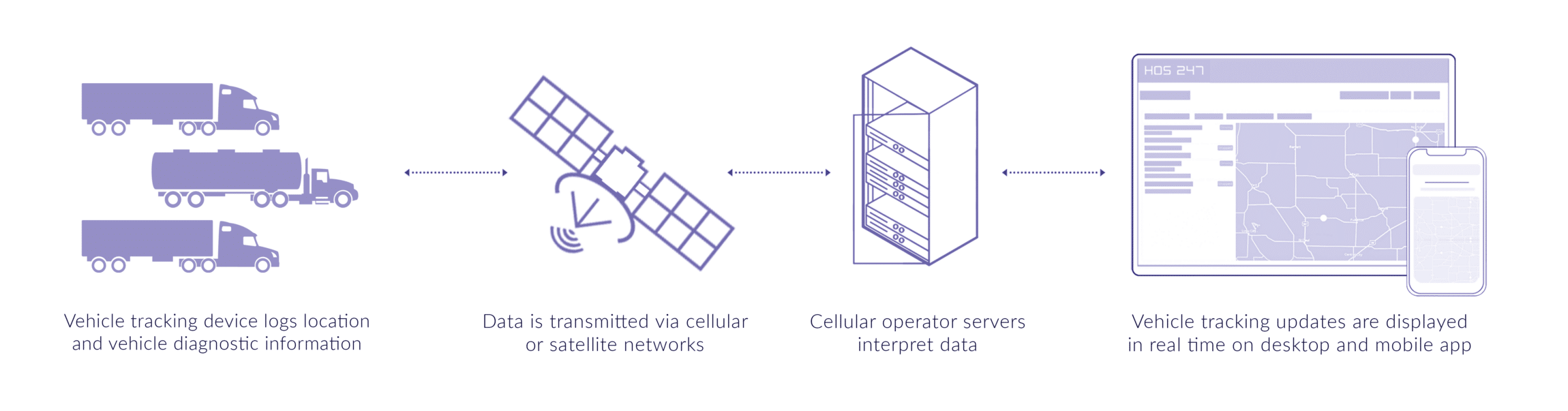
To fully appreciate the value of a fleet management system, it is helpful to understand the “invisible” relay race that happens every time a truck moves. While it may seem like magic when a location appears on your screen, it is actually the result of four sophisticated components working in perfect harmony.
The Core Components
The journey of a data point starts in the sky and ends on your dashboard through these four steps:
- GPS satellites. A network of satellites orbiting the Earth constantly broadcasts precise time and location signals. The tracking device in your vehicle receives these signals from at least four satellites to calculate its exact coordinates through a process called trilateration.
- The tracking device. Once the device knows where the truck is, it collects additional data from the vehicle’s engine (like speed, fuel levels, and fault codes).
- Cellular or satellite network. The device then “calls home.” Using a secure cellular network (typically 4G LTE), it transmits this encrypted data to central servers. If a truck enters a “dead zone” without signal, the device stores the data and sends it as soon as connectivity is restored.
- Fleet management software. Finally, the servers push this data to your HOS247 portal. The software translates raw GPS coordinates and engine codes into a user-friendly map, detailed reports, and real-time alerts.
Types of Fleet Trackers
Not all hardware is the same; the “best” tracker depends on how permanent you want the installation to be and what data you need to collect.
- Hardwired trackers. These units are connected directly to the vehicle’s electrical system, usually hidden behind the dashboard.
- Pros. They are tamper-proof, out of sight, and highly reliable because they don’t rely on a port that can be bumped or unplugged. They also provide the most comprehensive engine data.
- Cons. They require a more involved installation process (though still manageable for most fleet staff) and are less convenient to move between vehicles frequently.
- Plug-and-play (OBD-II) trackers. These devices simply plug into the vehicle’s diagnostic port (the same one a mechanic uses).
- Pros. Installation takes literally seconds. They are extremely portable, making them ideal for fleets that use rentals or move equipment often.
- Cons. Because they sit in the open, they are easier for a driver to accidentally (or intentionally) unplug.
By understanding these fundamentals, you can see that fleet tracking is not just about “spying” on a location — it is a sophisticated communication loop designed to provide you with the most accurate, real-time picture of your business’s health. Whether you choose the rugged reliability of a hardwired unit or the flexibility of a plug-and-play device, the result is the same: total operational control.
Advantages of HOS247 GPS Fleet Tracking Systems
At HOS247, we understand the importance of choosing the right GPS tracking system in the crowded market. We offer a reliable solution that caters to your fleet’s long-term needs. Our 4G GPS fleet management system comes with a wide range of benefits, making it an ideal choice for trucking companies. Let’s explore the significant advantages that HOS247 offers:
- Seamless ELD integration. Our system seamlessly integrates with our electronic logbook to meet compliance requirements for fleets involved in interstate commerce. The logbook supports all applicable FMCSA HOS rules to prevent violations. Managers can monitor drivers’ hours through the online portal.
- Reliable customer support. We take pride in offering top-rated customer support. Our multilingual support team is available seven days a week, ready to assist you in English, Spanish, Polish, and Russian. We even have a call-back policy to ensure continuous assistance, even if the call gets disconnected.
- User-friendly interface. Our intuitive fleet manager portal provides complete visibility and control over the fleet. Supervisors can access real-time data and make informed decisions based on the reports generated by the system.
- Dependable hardware. Choose from our range of high-quality, durable hardware options, including ELD-integrated hardware and concealed hardwired devices. Our hardware is built for optimal performance and reduced possibility of breakdowns. If anything were to happen during the first year, we will replace it for free.
- Quick and simple installation. Installing our system is hassle-free and takes only minutes without the need for a technician. Our web-based software can be easily accessed through any standard browser.
- No contracts and subscription plans. At HOS247, we do not require customers to sign long-term contracts, we prefer them to stay voluntarily. Truckers can subscribe to our plans and pay monthly or yearly, and scale their chosen plan up or down according to their fleet’s evolving needs.
- Cost savings. Our GPS system helps you identify efficiency gaps and extend the lifespan of your vehicles. By monitoring idling time, you can reduce fuel expenses and optimize fuel consumption. Additionally, the vehicle maintenance feature helps prevent breakdowns, minimize downtime, and maximize operational efficiency.
Choosing HOS247 GPS tracking systems for your fleet management needs brings a host of advantages that optimize operations, enhance safety and security, and deliver significant cost savings. With our advanced technology and unwavering commitment to reliability, HOS247 is your trusted partner in achieving efficient fleet management and maximizing your business’s success.

Characteristics of Dependable GPS Fleet Tracking Systems
Choosing the right GPS fleet tracking system is vital for maximizing efficiency, ensuring compliance, and achieving overall success. Whether you have decided to give HOS247 a try or look further, here is a list of factors to consider when selecting a GPS fleet tracking system to make sure it fits your needs:
- ELD integration. Look for a system that integrates with an electronic logging system (ELD) for compliance purposes. Managing different systems simultaneously can be time-consuming and inefficient.
- Hardware compatibility. Ensure the system’s hardware is compatible with your entire fleet, including trailers and different types of trucks. Additionally, look for a system that offers quick and straightforward installation to minimize downtime and avoid additional fees.
- Real-time tracking. Prioritize GPS trackers that provide real-time updates on your vehicles’ locations. While periodic updates may work for some businesses, real-time tracking offers improved security, reduced workload, and enables proactive decision-making.
- Efficient technical support. Access to prompt assistance is crucial for efficient fleet management and ensures a seamless user experience without unnecessary complications. Choose a system backed by a responsive and efficient customer support team. They should assist you with system implementation and optimization and be available to troubleshoot any issues that may arise.
- Easy-to-learn software. Select software that is user-friendly and minimizes the learning curve. A seamless user experience is essential for effectively managing complex technology without unnecessary complications.
- Demo or trial period. Prioritize providers that offer a demo or trial period, allowing you to test the system’s performance and suitability for your business. This ensures that you can make an informed decision based on firsthand experience and assess the system’s value to your operations.
- Total cost and value assessment. Evaluate the overall cost of the system, including upfront purchase and ongoing fees. Consider the value provided in terms of its features, functionality, and long-term benefits for your fleet management needs.
- Scalability. For a growing trucking business, your tracking system should be a bridge, not a bottleneck. Scalability is the platform’s ability to handle an increasing number of vehicles and data points without a drop in performance. A truly scalable solution allows you to onboard new units seamlessly, ensuring the software remains fast and responsive whether you are managing five trucks or five hundred.
- Integration capabilities. A GPS tracker shouldn’t exist in a vacuum; it should “talk” to the rest of your office. A dependable system offers integration with your existing business tools.
- Accounting software. Automatically sync mileage and fuel data (like IFTA logs) with platforms like QuickBooks to simplify payroll and tax filings.
- Maintenance programs. Feed engine diagnostics and precise mileage into your maintenance software to trigger service alerts before a minor issue becomes a costly breakdown.
By considering these factors, you can make an informed decision that aligns with your business needs and goals, ultimately leading to improved fleet management and success. At HOS247, we understand the benefits of fleet tracking for fleet management. Our GPS fleet tracking system offers cost-effective fuel management, theft prevention, streamlined operations, enhanced productivity, and increased driver safety. With our reliable and user-friendly solution, you can revolutionize your fleet management practices and drive your business towards success.
The Future of Fleet Tracking: Intelligence in Motion
The fleet management industry is currently standing at the precipice of its most transformative decade. In 2026, we are seeing the convergence of artificial intelligence, high-speed 5G connectivity, and sustainable energy — shifting the role of fleet tracking from simple location monitoring to a “cognitive” command center. At HOS247, we position our partners to stay ahead of these trends, ensuring your fleet remains competitive in an increasingly automated world.

The Role of Artificial Intelligence (AI) and Machine Learning
Artificial Intelligence is no longer a futuristic concept; it is the engine driving today’s most efficient fleets. By processing millions of data points in real time, machine learning algorithms can provide:
- Predictive maintenance. Instead of following rigid service intervals, AI analyzes engine vibration, temperature, and fluid levels to forecast mechanical failures weeks before they happen. This turns $50,000 engine catastrophes into manageable $3,000 proactive repairs.
- Dynamic route optimization. AI-powered routing goes beyond basic GPS by anticipating traffic patterns, weather shifts, and delivery window fluctuations, adjusting the driver’s path in real time to ensure peak efficiency.
- Intelligent driver coaching. AI identifies specific patterns in driving behavior — such as persistent tailgating or distracted driving — and provides automated, individualized feedback. This helps carriers move away from “blanket” training and focus on the specific needs of each driver.
The Rise of Video Telematics
The “blind spots” of traditional tracking are being eliminated by the integration of video telematics. By pairing high-definition dashcams with GPS data, carriers gain an unbiased, 360-degree view of every trip.
- Accident reconstruction. In the event of a collision, integrated video provides irrefutable evidence. This protects your business from “nuclear verdicts” and fraudulent claims where scammers target commercial vehicles.
- Theft deterrence. Beyond recovering stolen assets, AI-powered cameras can detect unauthorized cabin entry or cargo tampering, sending instant video alerts to dispatchers.
- Live safety monitoring. Modern dual-facing cameras use “Edge AI” to detect driver drowsiness or phone use locally, providing an immediate audible alert to the driver to prevent an accident before it occurs.
Integration with Electric and Autonomous Vehicles
As the industry moves toward sustainability, fleet tracking is evolving to manage the unique needs of electric vehicles (EVs). Modern systems now monitor battery state-of-health, optimize routes based on charging infrastructure, and calculate the real-time ROI of EVs versus diesel units. Furthermore, as Level 4 autonomous trucks begin navigating structured highway corridors, fleet tracking platforms will serve as the essential “remote supervisor,” monitoring the health and performance of unmanned convoys to ensure they reach their destination safely.

Driving Efficiency with a Reliable Partner
Fleet tracking has evolved far beyond a dot on a map. Today, it is the backbone of a successful trucking operation, providing the data-driven insights needed to lower costs, ensure safety, and meet the rigorous demands of modern logistics. By embracing these innovative technologies — from real-time GPS and ELD integration to the burgeoning power of AI and video telematics — you aren’t just managing a fleet; you are future-proofing your business.
At HOS247, we are committed to being more than just a software provider; we are your partner in this technological journey. Our reliable hardware, intuitive portal, and dedicated support team are designed to grow with you, ensuring that no matter how the industry changes, you always have full operational control.

As an expert in B2B and B2C sales, I’ve dedicated myself to perfecting sales processes and client retention strategies in the logistics and trucking industry. I have significantly contributed to the expansion of the ELD service, catering to retail and wholesale clients in need of HOS247 ELD solutions. My unwavering commitment to implementing state-of-the-art sales techniques and technologies ensures the continuous growth and success of businesses I work with.









If you are asking how many hours can a commercial driver drive, the federal rule is very clear. An interstate driver can legally drive up to 11 hours after taking 10 straight hours off duty. You must also complete all

Vehicle Log Book App for Android and iOS Electronic logging devices are a legal requirement for commercial drivers. They are also useful to streamline operations, stay on top of fleet maintenance, and save carriers time and money. An essential part
If you are looking for ways to cut operational costs, increase fleet security and streamline workflows, you may want to learn more about truck monitoring systems available on the market. Enhanced with telematics technology, GPS devices for truckers allow motor