
What Is a GPS Tracker for Trucks and How Does It Work?
At its simplest, a GPS tracker is a bridge between your truck and your business. But under the hood, it’s a sophisticated piece of hardware that utilizes a three-way “conversation” to keep your fleet visible and your data accurate.
The Tech Trifecta: GPS, Cellular, and Telematics
To understand how these devices work, think of them as having three distinct jobs.
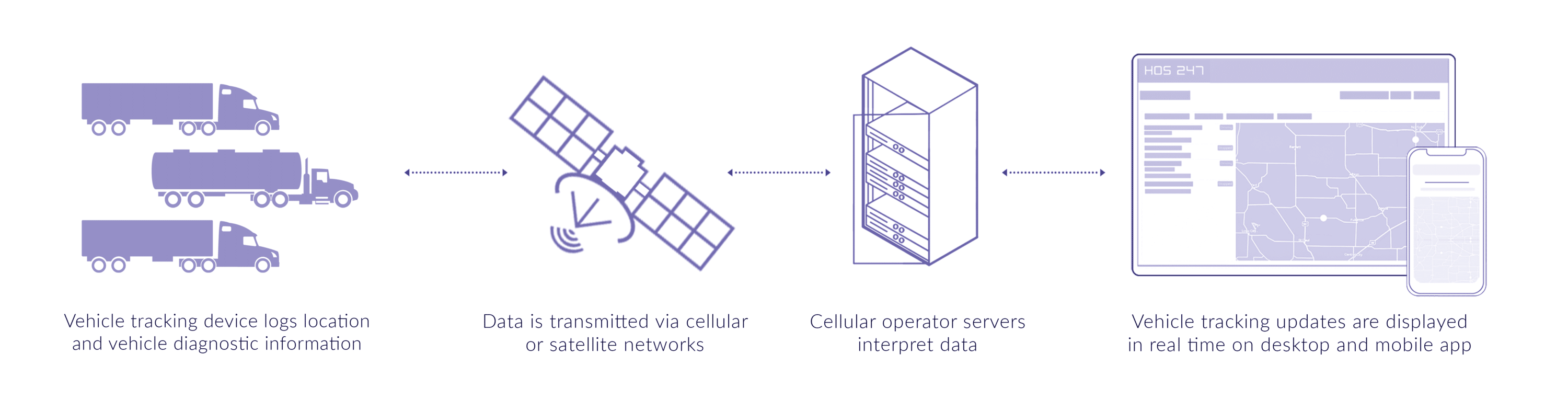
- The GPS layer (satellite). The device inside the truck receives signals from a constellation of Global Positioning System satellites. By calculating the time it takes for signals to arrive from multiple satellites, the device determines the truck’s precise latitude, longitude, and speed.
- The cellular layer (transmission). Once the location is determined, the device doesn’t just hold onto it. It uses cellular networks (similar to your smartphone) to “ping” that data to a central server in near real-time.
- The telematics layer (integration). This is where the magic happens. “Telematics” is the blending of telecommunications and informatics. The device taps into the truck’s internal computer system (the ECM) to pull engine health, fuel levels, and diagnostic codes.
Key Components of the System
A GPS tracking solution isn’t just a “black box”; it’s a full ecosystem consisting of three main parts:
- The tracking hardware. The physical unit installed in the vehicle. It contains the GPS module, the cellular antenna, and often an accelerometer to detect harsh braking or accidents.
- The software platform. This is the “brain” located in the cloud. It receives the raw data from the truck and translates it into maps, reports, and alerts.
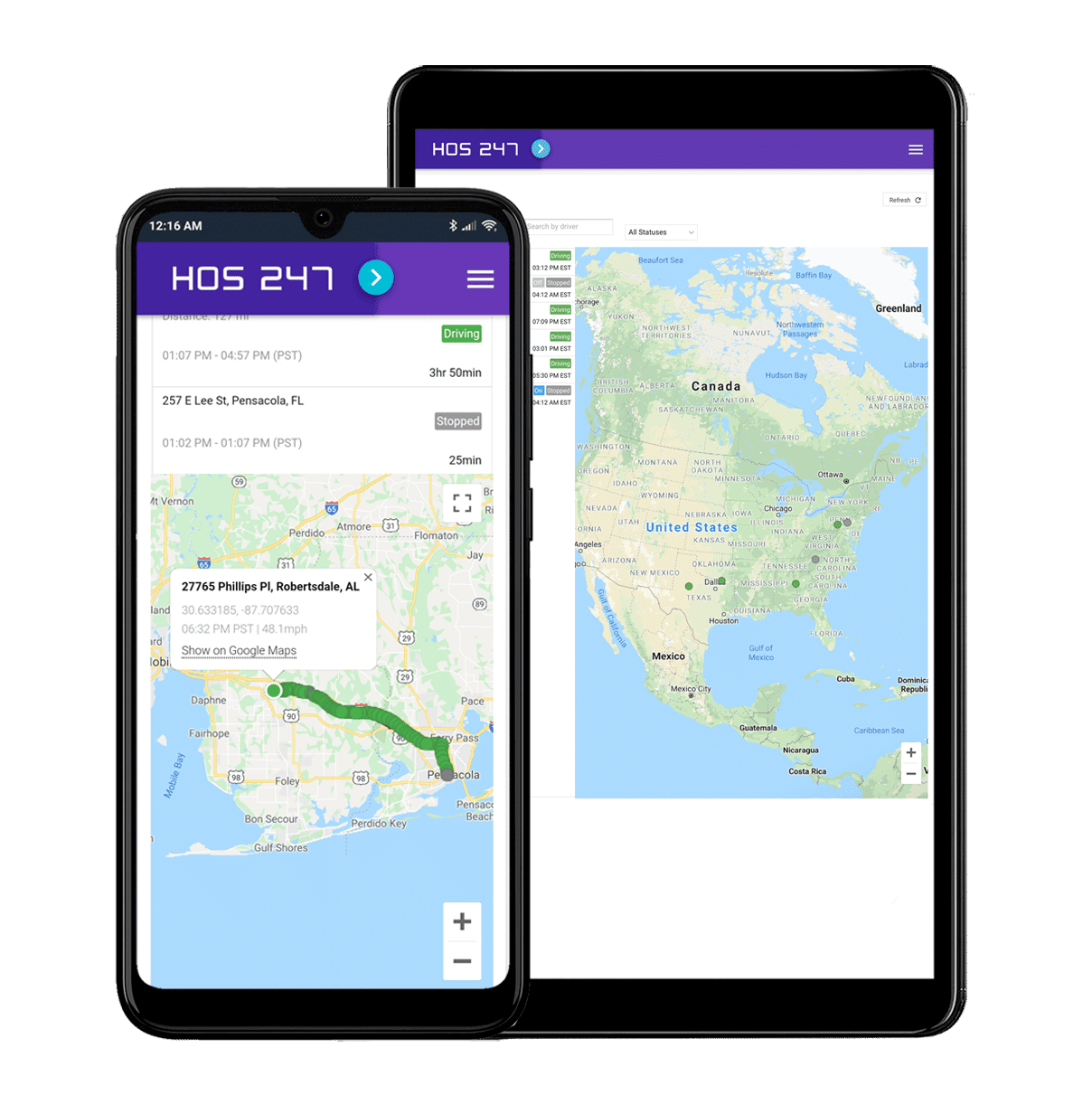
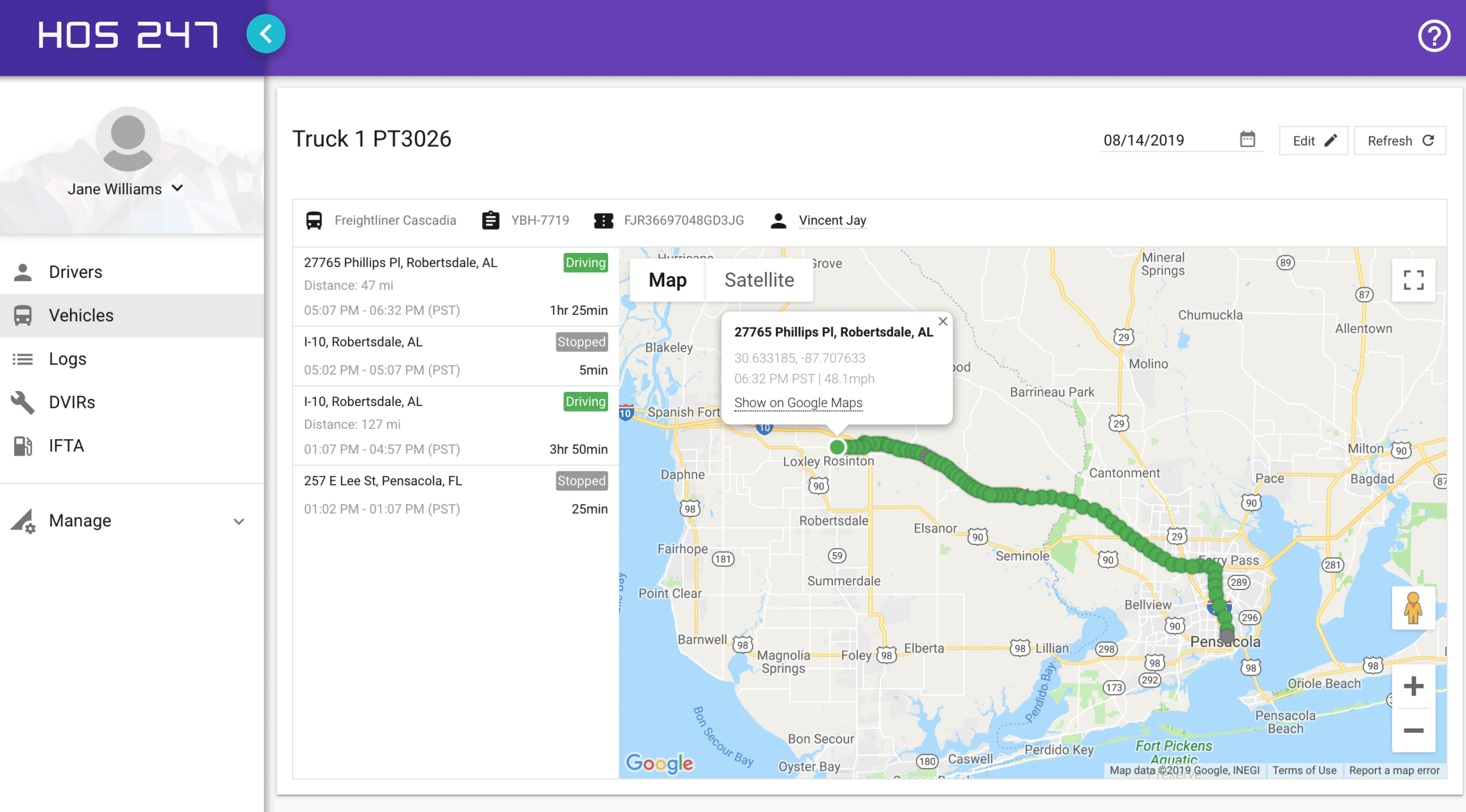
- The user interface. This is what you actually see. Whether you are at a desk using a Desktop Dashboard for deep-dive reporting or using a mobile app while on the move, the interface makes the data actionable.
The Data Stream: What Is Being Collected?
It’s not just about a dot on a map. Modern trackers collect a wealth of data points, including:
- Breadcrumb trails. A historical record of everywhere the truck has been.
- Engine diagnostics. Real-time monitoring of “Check Engine” lights and fault codes.
- Driver behavior. Data on speeding, excessive idling, and rapid acceleration.
At the end of the day, understanding the “how” behind GPS tracking helps you realize it is a sophisticated data-gathering machine that turns invisible signals from space into actionable insights on your screen. With this tool, you gain a level of “fleet-sight” that allows you to stop guessing ETAs and start knowing exactly where your overhead is going.
Choosing the Best Truck GPS Tracker
A reliable tracker will improve work efficiency and driver safety by monitoring vehicle location, usage and maintenance requirements. Business owners gain monetary and time savings by choosing a provider who offers the best services to optimize fleet operations and provide their drivers with better working conditions. What are the crucial characteristics to take into account while picking a GPS tracker for trucks?
- Compatible hardware. Fleet companies that use trailers as well as light- and medium-duty trucks for their services will benefit from a hardware that offers both plug-n-play and hardwired tracking options. Durability is another critical factor to consider as a high-quality electronic device avoids breakage and downtime.
- Easy installation. Look for hardware that doesn’t require special installation. If the system is too complicated, it may cost extra to install it. Ideal hardware is the one that your crew members can easily set up.
- Ease of use. User-friendly software is a vital feature in a GPS fleet tracking for trucks as it helps avoid moments of frustration and saves time.
- Demo or trial period. Make sure potential providers offer a trial period to test their trackers. Reliable companies that are sure of their products’ quality provide their clients with trials or demo versions. Take your investment seriously.
- Efficient technical support. Buying a high-quality GPS truck tracker is as critical as having access to reliable customer support to help you get the most out of the product. The provider should help you implement the device, troubleshoot, and timely answer any questions about the service.
Selecting the right GPS tracker is about finding a partner that understands the high-stakes reality of the road. As you evaluate your options, look beyond the sales pitch and focus on the practical. Whether you prioritize AI-driven safety, deep diagnostic data, or the simple freedom of a no-contract plan, the right choice will transform your tracking from a monthly expense into your fleet’s most valuable competitive advantage.
Types of GPS Trackers for Trucks
Not every truck or fleet has the same needs. Choosing the right hardware is about balancing ease of use with the depth of data you require. Here are the three primary types of trackers used in the industry today.
OBD-II Plug-in Trackers
These are the most common “plug-and-play” solutions. They slide directly into the On-Board Diagnostics port (usually located under the steering column).
- The pros. Installation takes about 30 seconds. There’s no wiring required, making them perfect for fleets that lease vehicles or need to move trackers between trucks quickly. They draw power directly from the port, so you never have to worry about batteries.
- The cons. Because they are easy to install, they are also easy to remove. A driver (or a thief) can unplug the device in seconds. Furthermore, while they provide great engine data, they might not be as “hidden” as some fleet owners prefer.
Hardwired Trackers
For those who want a permanent, “set it and forget it” solution, hardwired devices are the gold standard. These are installed behind the dashboard and connected directly to the vehicle’s power and ignition wires.
- The pros. They are virtually tamper-proof because they are hidden from sight. Because they are integrated deeply into the truck’s wiring, they often provide more robust data, such as PTO (Power Take-Off) monitoring for specialized equipment like mixers or tow trucks.
- The cons. They require a bit more “elbow grease” or professional installation. If you need to decommission a truck, it takes more time to swap the hardware to a new unit.
Battery-Powered (Asset) Trackers
While trucks have engines to provide power, your trailers, containers, and heavy equipment do not. This is where battery-powered trackers shine.
- The pros. These are completely self-contained units. They feature long-life batteries that can last anywhere from six months to five years depending on how often they “ping.” They are rugged, weather-resistant, and can be mounted anywhere with magnets or screws.
- The cons. Because they rely on internal batteries, they typically don’t provide “second-by-second” tracking. Instead, they might update their location 2–4 times a day to conserve power, making them better for recovery and inventory than for active navigation.
There is no “one-size-fits-all” when it comes to tracking hardware. By matching the specific tracker type to the job at hand, you ensure that you aren’t paying for more tech than you need, while still protecting every asset in your yard. The right choice doesn’t just track your location; it fits seamlessly into your daily maintenance and security routine without adding extra work to your plate.
Key Features to Look For
When you’re shopping for a GPS tracker, it’s easy to get blinded by flashy dashboards. However, for a trucking operation, the “bells and whistles” don’t matter if the core features don’t save you time or money. Here are the non-negotiables you should look for.
Real-Time Tracking vs. Breadcrumbing
There is a massive difference between “knowing where your truck was” and “knowing where your truck is.”
- Delayed tracking (breadcrumbing). Some cheaper units only update every 5 to 10 minutes. By the time you see a “stop,” the driver could already be 8 miles down the road.
- Real-time updates. High-quality trackers update every 30 seconds or even every few seconds. This is critical for accurate ETAs, recovery in case of theft, and providing customers with live tracking links that actually reflect reality.
Driver Behavior Monitoring
Your trucks are your biggest assets, and how they are driven determines their lifespan. Modern trackers monitor “g-force” events like harsh braking, rapid acceleration, and sharp cornering.
- Safety. Reducing aggressive driving lowers the risk of accidents and insurance claims.
- Wear and tear. Smooth driving means fewer brake jobs, less tire wear, and a longer life for your transmission.
Route Optimization
Fuel is often a fleet’s highest variable cost. Route optimization isn’t just a GPS map; it’s an engine that calculates the most efficient path based on truck-specific restrictions (bridge heights, weight limits) and real-time traffic. This ensures your drivers aren’t burning “deadhead” miles or getting stuck in construction.
Maintenance Alerts
Stop relying on stickers in the window. GPS trackers pull actual mileage and engine hours directly from the truck’s computer. You can set the system to alert you when a truck is 500 miles away from an oil change or a 90-day inspection. Proactive maintenance prevents the $5,000 roadside repair that could have been a $500 shop fix.
Fuel Monitoring & Idling Reports
Idling is essentially burning dollar bills while standing still. Trackers can report exactly how long an engine has been running without the truck moving. By identifying “heavy idlers,” you can coach drivers to shut down the rig, potentially saving thousands in fuel costs per truck, per year.
Dash Cam Integration
In the “he-said, she-said” world of road accidents, video is your best witness. Many GPS systems now integrate with AI dash cams. When a harsh braking event occurs, the system automatically uploads a video clip to the cloud, often proving the driver wasn’t at fault before the police report is even written.
ELD Integration
While we’ll dive deeper into this later, your GPS tracker should ideally play nice with your Electronic Logging Device (ELD). Having your HOS (Hours of Service) and GPS data in one app simplifies life for the driver and keeps your back office from having to manage two different subscriptions.
A GPS tracker is only as good as the problems it solves. If you aren’t using these features to reduce fuel waste or extend the life of your equipment, you’re just paying for a map. Choose a system that turns “tracking” into “managing” by giving you the data you need to make better decisions on the fly.
Comparison of the Best GPS Trackers for Trucks
The telematics market is a mix of high-tech “all-in-one” ecosystems and flexible, driver-centric tools. When comparing these providers, it’s important to look past the marketing and focus on three things: total cost of ownership, contract flexibility, and the quality of support when you’re stuck on the side of the road.
HOS247
HOS247 stands out in the market for owner-operators and small-to-mid-sized fleets by prioritizing transparency and ease of use. The platform offers a robust fleet management suite that includes real-time GPS fleet tracking, automated IFTA reporting, and FMCSA-certified ELD compliance.
- Pricing. The ELD Compliance plan starts at $19 per vehicle/month, while the ELD Track plan (which includes full GPS tracking) is positioned at $22 per vehicle/month. Hardware is typically free with an annual plan or available for a one-time fee of $79 for monthly subscribers.
- Contract terms. HOS247 maintains a strict no-contract policy, allowing for month-to-month flexibility with no early termination penalties.
- Key features. Real-time location updates, maintenance reminders, IFTA automation, and human-centric support every day of the week.
Why Truckers Choose HOS247
In a market where “big tech” is moving toward more restrictive contracts, HOS247 has stayed committed to a driver-first philosophy. We recognize, the economy is fast-moving, and fleet owners need the ability to pivot.
- Freedom of choice (no contracts). We don’t believe in “locking” you into a relationship. Our month-to-month plans mean we have to earn your business every single month through high-quality service and reliable hardware.
- Multilingual human support. Automated chatbots are fine for basic questions, but when a driver is at a roadside inspection or a truck is missing, you need a human. We offer top-tier support in English, Spanish, Polish, and Russian, so no detail is lost in translation.
- No hidden fees. Large providers often have complex “per-feature” add-ons. We offer transparent pricing tiers that include the essentials (GPS, ELD, and IFTA) without the extra fees at the end of the month.
Before signing on the dotted line, ask yourself: “If my fleet size changes next year, will this company help me or penalize me?” At HOS247, we grow with you. We’ve stripped away the corporate red tape to provide a powerful, tracking and compliance tool that respects your independence as a carrier.
Motive (formerly KeepTruckin)
Motive has transitioned into a massive “Automated Operations” platform, leaning heavily into AI-driven safety features. While they offer a “self-installation” model, their pricing is often customized based on fleet size.
- Pricing. Standard fleet management typically starts around $30 per vehicle/month, but adding AI dash cams often brings the total monthly cost to $70+ per vehicle. Hardware for cameras and ELDs can range from $150 to $400 upfront.
- Contract terms. While some 12-month terms are available, many advanced safety and AI features typically require 36-month agreements.
- Key features. AI-powered dash cams, real-time driver coaching, and a highly-rated mobile app for HOS compliance.
Verizon Connect (Reveal)
Verizon Connect is a legacy provider built for large-scale enterprise operations. While their “Reveal” platform is robust, user feedback continues to highlight a rigid corporate structure and a focus on long-term commitments.
- Pricing. The Reveal Starter plan typically starts around $23.50 per vehicle/month, but full-featured packages generally range from $35 to $45 per vehicle/month.
- Contract terms. Most standard agreements require a 36-month minimum commitment and include auto-renewal clauses that require a 60–90 day notice to cancel.
- Key features. Drag-and-drop scheduling, “Helicopter View” aerial tracking, and native connectors to major enterprise ERP platforms like SAP.
Geotab
Geotab is a “data-first” provider that operates exclusively through a third-party reseller network. This allows for extreme customization but means your experience depends entirely on your chosen vendor.
- Pricing. Software and hardware bundles via resellers typically average between $30 and $40 per vehicle/month. If buying hardware outright, units generally cost between $80 and $120 each.
- Contract terms. Terms vary by reseller, ranging from month-to-month to 3-year commitments.
- Key features. Open API for custom integrations, 15-second data refresh rates, and the ability to detect in-vehicle reverse collisions.
Rhino Fleet Tracking
For those looking for a budget-friendly, “just the basics” approach, Rhino Fleet Tracking remains a steady contender for local service fleets.
- Pricing. Standard tracking starts at $16.95 per vehicle/month (requires a 3-unit minimum), while single-unit or asset-only plans often start at $18.95/month.
- Contract terms. Offers no-contract, month-to-month plans, which is their primary competitive advantage alongside HOS247.
- Key features. Breadcrumb route history, basic geofencing, and 24/7 US-based email and phone support.
Disclaimer: The information provided in this comparison is based on market research and publicly available data as of early 2026. Pricing, contract terms, and feature sets are subject to change without notice. We recommend contacting each provider directly for a formal quote tailored to your specific fleet requirements.
HOS247 Customer Care Policies
The flexible and customer-centered policies of HOS247 have made our company a top-rated fleet management provider. We use a wide range of technological and business tools to provide our clients with reliable service. The benefits we offer customers include:
- No contract policy. At HOS247, we don’t bind our customers with a long-term contract. Instead, we adjust to their needs by offering monthly and yearly subscription plans. You can easily scale up and down your plan depending on your necessities.
- Two-week trial and demos. If you want to test our service before subscribing to a plan, we invite you to try our devices for two weeks. Request your demo to discover how efficient and reliable our services are.
- Hardware replacement warranty. Our devices are dependable and resistant. HOS247 hardware comes with a one-year free replacement warranty in case of malfunction.
- Top-rated customer support. Doubts and questions are inevitable. HOS247 offers efficient Monday-to-Sunday service. Our international team of professionals will help you with troubleshooting, compliance questions, and the everyday use of our devices. his is backed by our strict callback policy, ensuring that if a connection is lost, our team takes the initiative to reach back out to you immediately.
- Callback policy. We know how frustrating it may feel to be hung up on the phone when you need assistance. If the call drops, your rep will call you back so you don’t have to explain the issue again.
In the trucking world, a technical glitch at a weigh station or a roadside inspection isn’t just an inconvenience — it’s a threat to your uptime and your CSA score. This is why HOS247 is proud to offer a quality system backed up by efficient technical support that truckers can rely on.
Benefits of the HOS247 GPS Tracking System
HOS247 GPS fleet trackers use reliable technology to provide an accurate, efficient, and smooth service. AI-powered tools and a set of extra features increase safety and help reduce overall expenses.
- Real-time updates & 4G connectivity. The tracker utilizes high-speed 4G technology to ensure that your is accurate and immediate. This means that the “live map” you see on your dashboard is a true reflection of the road, giving you a faster response time.
- Dependable hardware and intuitive interface. Our hardware is made with high-quality materials that make it more resistant and durable. The software is easy-to-install and has an intuitive interface that helps manage tasks smoothly and save time.
- Improved safety and security uses. The HOS247 GPS tracker for trucks informs fleet managers if the driver heads to an unauthorized location and can help recover stolen assets.
- Extra features to improve fleet management efficiency. The HOS247 GPS fleet tracker for trucks has idling monitoring, a feature that considerably reduces fuel expenses. It also includes code detection and preventative maintenance to help prevent downtime due to breakdowns and improve overall performance.
By integrating real-time visibility with automated IFTA reporting and proactive maintenance alerts, you effectively eliminate the manual paperwork that eats into your drive time. This “all-in-one” approach doesn’t just lower your overhead through fuel savings and reduced wear and tear; it provides the data-driven proof you need to command higher rates from shippers who value reliability.
HOS247 GPS Trackers Integrate with ELD
The HOS247 GPS tracker for trucks can integrate with an electronic logging system, which is indispensable for fleets that conduct interstate commerce. The elog helps achieve FMCSA compliance and prevent HOS violations and fines.The rule was implemented to ensure safety of the road by tracking driver’s house of service records. By synchronizing with the vehicle engine, the electronic logging device is able to record driving time and create driver’s records of duty status, helping them achieve FMCSA compliance.
Who must use electronic logging devices?
Current federal legislation requires most commercial drivers, subject to HOS, to record driving hours using an approved electronic logbook. However, FMCSA allows limited exemptions to the ELD mandate for the following categories:
- Short haul drivers.
- Drivers who keep paper RODS for not more than eight days out of a 30-day period.
- Drivers of drive-away-tow-away operations.
- Drivers of vehicles with engines manufactured before 2000.
Who sets up requirements for ELD devices?
The Department of Transportation designs the requirements for electronic logbooks. Any ELD systems have to be approved by the Federal Motor Carrier Safety Administration.
What are these requirements?
- Official certification from the manufacturer.
- Conformity to technical specifications set by the DOT.
- Registration with the FMCSA.
- Supporting documents for drivers: ELD user manual, instructions in case of malfunction and a data-transfer guide.
HOS247 is a top-rated ELD provider approved by the FMCSA. Our BYOD electronic logbooks are efficient and easy to use. Visit our HOS247 App Reviews page to find out what our clients think about the service and request your demo.
Key Functions of an ELD
Electronic logging devices are meant to improve HOS compliance while automating trucking processes. Some of the functions they provide are:
- Synchronization with the engine control unit (ECU). The ELD connects directly to the vehicle’s engine to automatically capture critical data such as engine status, ignition cycles, and movement, eliminating the need for manual input.
- Automatic recording of driving activity. The device tracks driving time, vehicle motion, and duty status changes in real time, ensuring accurate and compliant HOS logs without relying on driver memory.
- Detailed monitoring of vehicle parameters. The ELD continuously records key metrics like engine hours, speed, mileage, and location to provide a complete and reliable view of vehicle operation.
- Collection of vehicle performance data. The system gathers operational insights that help identify inefficiencies, detect potential issues early, and improve overall fleet performance.
- Electronic data transfer via telematics or Bluetooth. The ELD enables fast, secure sharing of log data with enforcement officers during roadside inspections using wireless or local transfer methods.
- Built-in tamper prevention mechanisms. The device includes safeguards that prevent unauthorized changes to log data, ensuring compliance and maintaining a trustworthy audit trail.
- Driver record certification tools. Drivers can review, verify, and electronically certify their logs at the end of each shift, reinforcing accountability and accuracy.
- On-demand reporting for safety officials. The ELD generates standardized reports instantly, allowing drivers to quickly present required documentation during inspections or audits.
- Integrated user manual and guidance. The system provides in-device instructions and support resources, helping drivers understand proper usage and stay compliant with regulations.
- Audio and alert controls. The ELD delivers audible notifications and alerts for key events, such as approaching HOS limits or system issues, helping drivers stay informed without distraction.
Electronic logging systems can be of two types according to the device used to display the data collected by the hardware piece:
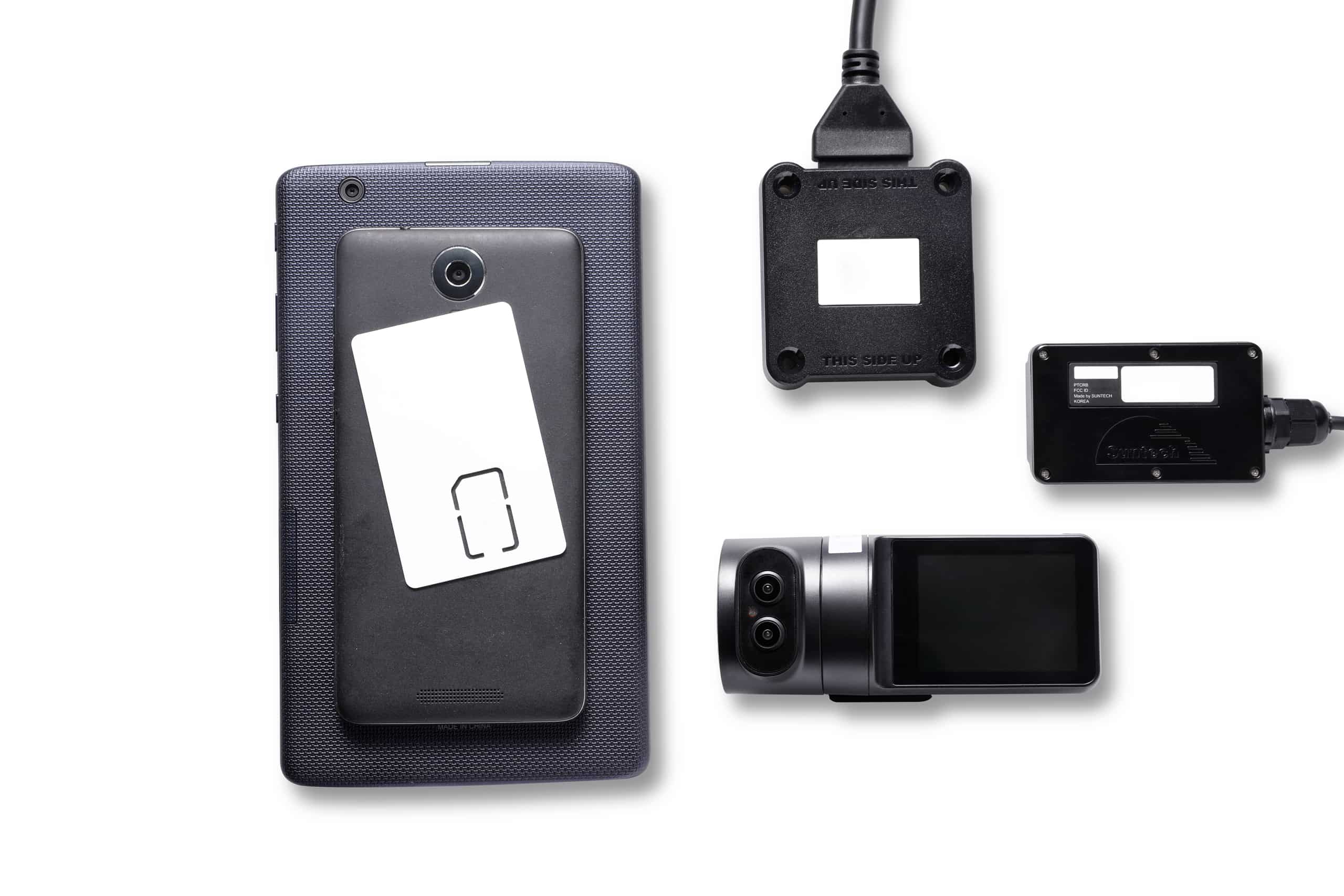
- Manufacturer’s proprietary tablets. The service provider includes a tablet with a preloaded mobile app.
- Bring your own device (BYOD) solutions. The logbook app can be downloaded from app distribution platforms like Google Play or the App Store and installed on the driver’s smartphone or tablet of choice.
By automating the transition between drive time and on-duty status, the system removes the risk of human error and ensures your HOS logs are always inspection-ready. Ultimately, these key functions turn a mandatory compliance tool into a powerful asset that protects your CDL, keeps your fleet on the right side of the FMCSA, and allows you to focus on the road instead of the paperwork.
How GPS Fleet Tracking + ELD Can Improve Your Trucking Business
Having a GPS tracker and an ELD isn’t just about following the law; it’s about survival. When you combine these two technologies, they stop being individual gadgets and start acting as the central nervous system of your business. Here is how that integration translates into a better run operation.
Streamlined Operations and Unified Compliance
Managing a fleet is hard enough without having to jump between five different apps to see where your trucks are and how many hours your drivers have left. An integrated GPS and ELD system puts all your data under one roof:
- Real-time availability. Dispatchers can see a driver’s location and their remaining HOS (Hours of Service) simultaneously. This prevents the “over-dispatching” that leads to forced violations and hefty FMCSA fines.
- Automated IFTA reporting. By syncing GPS mileage with fuel purchases, the system automatically calculates exactly how many miles were driven in each jurisdiction. This eliminates hours of manual paperwork every quarter and significantly reduces the risk of an audit error.
Increased Profitability and ROI
A quality tracking system should pay for itself within the first few months. The return on investment (ROI) comes from “plugging the leaks” in your overhead:
- Fuel savings. By monitoring idle time and optimizing routes to avoid traffic or construction, fleets typically see a 10–15% reduction in fuel spend.
- Asset lifecycle. Maintenance alerts based on real-time engine hours mean you’re changing oil and rotating tires exactly when needed — not too early (wasted money) and not too late (expensive breakdowns).
- Lower insurance premiums. Many insurance providers now offer “telematics discounts” of up to 25% for fleets that can prove they use active monitoring and driver coaching.
Enhanced Safety and Security
Your trucks are your livelihood, and protecting them is paramount:
- Driver coaching. Using data on harsh braking and rapid acceleration allows you to identify “high-risk” habits before they lead to a $50,000 accident.
- Theft recovery. If a trailer is unhooked or a truck is moved after hours, you get an instant alert. Concealed trackers provide law enforcement with a live “breadcrumb” trail, often leading to a recovery within hours rather than days.
Improved Customer Service and Reliability
Shippers expect transparency. They don’t want to hear “the driver says he’s an hour out” — they want to see it:
- Accurate ETAs. With real-time traffic integration, you can provide customers with a live tracking link. If a delay occurs, you can proactively notify them, building a reputation for reliability that earns you repeat business.
- Proof of delivery. GPS provides a digital “stamp” of exactly when a truck arrived and departed, which is your best defense against detention fee disputes.

Final Thoughts: Why Visibility is the Key to Trucking Profitability
The gap between “old-school” trucking and modern fleet management is widening. Today, success is determined by data — who has it, how fast they can see it, and how they use it to protect their bottom line.
Choosing a GPS fleet tracking solution is one of the most significant decisions you will make for your fleet this year. Whether you opt for a plug-and-play OBD-II device for its simplicity, a hardwired unit for its security, or a battery-powered tracker to keep tabs on your trailers, the goal is the same: total visibility.
At HOS247, we believe that you shouldn’t have to sign a 3-year “legal trap” just to get high-quality data. By offering a no-contract, multilingual, and fully integrated ELD and GPS solution, we give you the tools of a mega-fleet with the flexibility of a small business.
Don’t let your business run on guesswork. Invest in a system that works as hard as your drivers do, keeps you compliant with the FMCSA, and ensures that every mile you drive is a mile toward a more profitable future.

I’ve co-founded, built and managed several transportation-related businesses. Now, I’m a founder and CEO of HOS247 – an AI Transportation Platform for trucking companies, freight brokers and other logistics operations. We are transitioning old-style operations to technology-advanced logistics entities and help them to grow their businesses. ELDs (electronic logging devices), fleet tracking and management 2.0 combined with AI-powered dispatch tools.








As a trucker, you know that using an electronic logging device (ELD) is required by law. The FMCSA mandates that most commercial drivers use electronic logbooks to track their hours of service (HOS). However, with so many electronic log companies
With the enforcement of the ELD mandate, truckers require electronic logbooks to demonstrate compliance with HOS regulations. While the need for a feature-loaded elog device is a priority, the long-standing debate on whether to choose an Android or iOS elog
When the ELD mandate took effect, it changed the reality for every professional driver on the road. Electronic logbooks went from optional equipment to required tools that every commercial truck must have. For both independent drivers and fleet managers, selecting