Drivers are the most important part of a successful trucking business. Trucking companies must give drivers the right tools to do their job, including the best ELD logbook, which means a device that works reliably. It must gather and send data accurately and use simple software that is easy to manage.
Finding the right device on the market can be tough for trucking companies. The government list lets any manufacturer add their device before it faces real-world testing. This makes it easy to buy an unstable system that freezes or drops its connection. Finding a provider with a proven track record keeps your records correct and ready for roadside checks.
HOS247 is a strategic partner, a collaborator to help your business thrive, offering a dependable and efficient ELD solution with premium customer service. We provide quality devices with premium services for truckers, who rate us highly on app distribution platforms. In this article, we will tell you more about HOS247 electronic logbooks and other major providers in the industry to help you find the best logbook for your vehicle or fleet.
Do you have any questions? Talk to ELD Advisor: 650-405-3372 or Request Callback
HOS247 Is a Top-Rated ELD Provider
The HOS247 ELD is easy to use, dependable, and complete. It gives truckers a simple tool to manage logs and improve operations. We combine a quality product with a smart layout and a helpful support team to keep your fleet ready for the road.
Checking app store ratings shows exactly how different logging programs work for real drivers on the road. Looking at these scores reveals that some systems crash or are hard to navigate, while others stay highly rated because they work well in the field.
1HOS247
[HOS247 Ratings on Google Play Store and Apple App Store]
2Big Road
[BigRoad Truck Driver Log Book Ratings on Google Play Store and Apple App Store]
3Omnitracs
[HoursGo Ratings on Google Play Store and Apple App Store]
4JJ Keller
[ENCOMPASS® ELD Ratings on Google Play Store and Apple App Store]
5Ezlogz
[Ezlogz: ELD & Truck Navigation Ratings on Google Play Store and Apple App Store]
6Geotab
[Geotab Drive Ratings on Google Play Store and Apple App Store]
7VisTracks
[VisTracks Ratings on Google Play Store and Apple App Store]
8PeopleNet
[PeopleNet ConnectedDriver Ratings on Google Play Store and Apple App Store]
9Garmin
[Garmin eLog Ratings on Google Play Store and Apple App Store]
10Verizon
[REVEAL ELD Logbook Ratings on Google Play Store and Apple App Store]
Why a High App Score Matters
A high app score matters because it shows the program stays up and running on long trips. An electronic logbook needs to run smoothly in the background. It should not freeze when you answer a phone call or open a map. Reliable software keeps your data from getting lost and gives you peace of mind during a roadside inspection.
Signs that You Need a Better ELD
Drivers often run into problems with their logs that waste time and cost money. Checking out logbook providers now can save you a lot of headaches later. The best ELD logbook helps you avoid these setbacks. If you deal with these common issues, it might be time to switch to a better option:
- Bad customer support. Support after you buy a device is a massive part of the service. Drivers will eventually need help from their provider, but some support teams are nowhere to be found. A broken log means you lose money, so an accessible support team is necessary.
- Complicated logbooks. The best logbook cuts down on your workload. Managing your hours should be a straightforward task, but many apps make it hard. Reviewing logs and showing reports to inspectors should take only a few taps on the screen. If you struggle with these basic tasks, there is room for improvement.
- Hidden fees. One of the worst setbacks is seeing a cost you did not expect. Some providers are not honest about their pricing. They surprise you with extra fees for training, activation, or proprietary tablets. Your provider should be a partner you can trust.
Spotting these warning signs early can keep you from getting fined at the scale house. Dropped Bluetooth links, lost logs, and sudden screen restarts while driving show that a system is unstable. If drivers have to constantly unplug the hardware or restart the app to keep it connected to the engine, it is time to switch to a better option.
The Risk of Marketplace Instability: Federal Register Revocations
Picking a provider is about more than everyday app performance. You also need to check if the device manufacturer stays approved by the government. Bad hardware or poor engineering can cause an elog to lose its legal status entirely.
How the Government Removes Bad Devices
The FMCSA checks the market and removes non-compliant systems from its approved list. If a provider fails to update their software or if the hardware logs engine data incorrectly, the government revokes its certification. Once a device is revoked, you can no longer legally use it to track your hours.
Avoiding Emergency Deadlines
When the government removes a device from the list, trucking companies have to act fast. The FMCSA usually gives you a strict 60-day window to buy and install completely new hardware across all your trucks. Using revoked equipment after that deadline leads to immediate out-of-service violations. That is why it is so important to pick an established provider from the start.
What Other Features Are Needed for Trucking Operations?
First, the best ELD logbook must meet all DOT rules so you can run legally. But you can get much more value out of an elog. Here are a few extra tools that can cut down on paperwork and make your job easier:
- Automated fuel taxes. This tool automatically calculates the miles you drive in each state. It cuts down on human errors on your tax forms and helps you manage your paperwork faster.
- GPS fleet tracking. Electronic logbooks often come with a built-in GPS tracker. This lets fleet managers see where trucks are in real-time, which helps them make better choices and assign loads safely.
- Bring your own device (BYOD). The best logbook must fit your fleet’s needs. It helps to pick an elog system that works across multiple brands of smartphones and tablets so drivers can use their own devices.
- Fleet maintenance. Fleet managers can schedule regular shop visits to keep trucks in top shape. This keeps operations running smoothly and saves money by preventing breakdowns.
- Vehicle diagnostics. Engine fault alerts tell the driver right away if there is a mechanical problem with the truck.
Putting all your tools into one stable program keeps your cab clean and organized. Combining your logs with fuel tax tracking, maps, and engine diagnostics stops you from switching between different apps. This single screen saves time for office staff and helps drivers check their data quickly.
More Benefits of HOS247 ELD
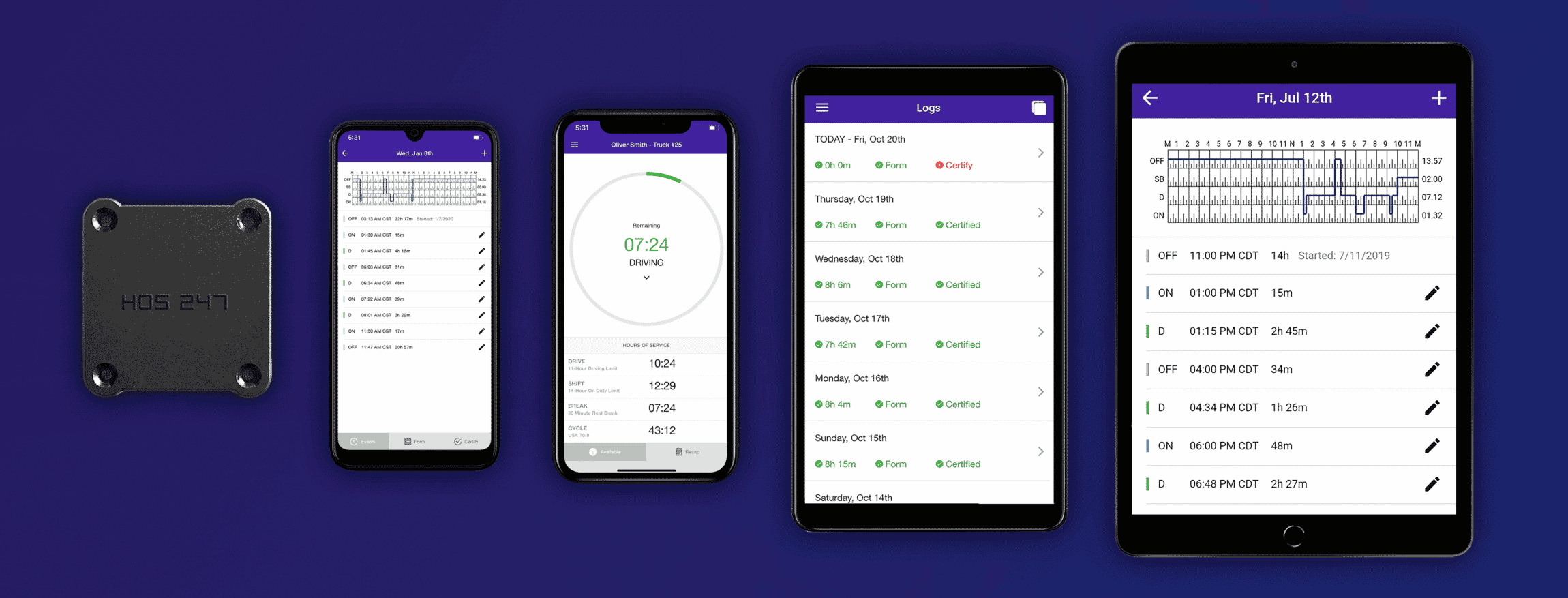
HOS247 provides a service built on reliability and compliance. Our simple tools, helpful support team, and focus on being a true partner make our elog one of the best choices on the market. Here are more benefits of our system:
- High-quality hardware. Our hardware is fully tested and proven. The Bluetooth connection stays steady and fast to gather your data in real-time.
- Compatible software. The HOS247 app runs perfectly on both Android and iOS devices, so drivers can use whatever phone they prefer.
- Top-rated customer support. Our team answers the phone seven days a week in English, Spanish, Polish, and Russian to help with any issue on the road.
- Extra features. We optimize your business by automating fuel tax forms, idle tracking, and vehicle maintenance schedules.
- Trial period. You get two weeks to test the system and see how it works. If you are not happy with it, you can return it for your money back.
- No contract policy. We use a basic subscription plan. You do not have to sign any long contracts. You can pay monthly or yearly based on what fits your business.
These simple features and flexible plans give trucking companies a stable foundation. This reliability extends beyond the phone screen directly to the hardware inside the cab. Managing a fleet requires a system that works easily with different trucks, making hardware versatility a critical factor for daily work.
Selecting Hardware for Diverse Vehicle Classes
Trucking companies often use a mix of different trucks for their routes. A good logging system must work smoothly across all these different vehicle types without forcing the office to use separate software programs.
Cables That Fit Different Trucks
Commercial trucks use different plug styles based on their size and age. Heavy-duty trucks usually use a standard 9-pin port to link engine data to the logbook. Light- and medium-duty trucks, like delivery vans or hotshot pickups, use an OBDII port instead. A good provider handles this by offering cables for both styles, ensuring the hardware plugs right into the engine.
Keeping All Your Records in One Place
When the hardware plugs easily into any truck model, safety managers can view all fleet data in one main online portal. Drivers can switch from a heavy-duty semi to a medium-duty truck during their shift while keeping their hours running on the same mobile app. This keeps your records organized and saves the safety department from jumping between different software programs.
ELD-Related Fines and CSA Scores
The government tracks trucking companies using a safety scoring system. These safety scores update monthly based on roadside inspections, crash reports, and safety violations. A score near 100 is the worst, while a score near 1 is the best. As a company gets violations, their safety scores go up, and insurance costs rise too.
There are 22 direct violations related to the use of ELDs that lower your safety scores. The most common violations include:
- Using the wrong method to track hours. Up to 7 points.
- Incomplete logs or mistakes. These add 5 points and include things like failing to report a broken device or hiding the screen from the inspector.
- Minor violations. These add 1 point and include missing your ELD manual, forgetting to sign your logs, or leaving out shipping numbers.
The long-term cost of these violations can hurt your business. Piling up safety points damages your scores, which insurance companies check when setting your yearly rates. Bad scores also mean inspectors will pull your trucks into scale houses more often, leading to full company audits.
Fines add up quickly because the government charges you per violation every day. Failing to keep proper logs can cost up to $1,584 per day, topping out at $15,846 per occurrence. Knowingly faking an electronic log line carries a fine of up to $39,615. For serious safety violations, companies face fines up to $19,246, while drivers can be fined up to $4,812. If a driver gets put out of service for missing hardware or unauthorized apps, the truck is grounded immediately, causing missed delivery slots and lost contracts.
Frequently Asked Questions About ELD Logbooks

An ideal electronic logbook for an independent driver focuses on simple operation, a clear pricing plan, and a zero-contract policy. Owners need a system that installs fast and tracks hours accurately without hidden fees. A monthly subscription plan lets drivers manage expenses easily and gives them the freedom to cancel or change plans without paying penalties.
Carriers check the legal status of an elog by looking up the manufacturer on the official FMCSA registry list. Because the registry allows companies to add their own devices, you must make sure the hardware model and software version match the approved list exactly. Checking the list before you buy protects you from deploying a non-compliant or revoked system.
To avoid documentation fines during an inspection, a driver must keep four items inside the truck cab. These are the printed ELD user manual, a sheet showing how to transfer data to the officer, a guide explaining what to do if the device breaks, and a supply of blank paper logs to track at least eight days of driving. Missing any of these sheets results in an automatic violation.
Government rules completely lock out the ability to edit or change automatic driving time recorded by the engine plug. If the truck moves and triggers the driving line, that data stays locked to prevent tampering. For minor corrections, like adding a note about a yard move or fixing a missed logout, the app lets you type remarks that the office can approve to update the log file.
Stable hardware maintains a steady Bluetooth link to your phone screen, which lets you open the DOT inspection mode instantly. When an officer asks for your data, reliable software packages the logs and sends them through right away. This fast sharing speeds up the safety check, reduces your time spent at the scale house, and gets you back on your route quickly.
Choosing a Secure Compliance Partner
Choosing the best ELD logbook is the most important step for meeting DOT rules and running an efficient business. Whether you are a small owner-operator or manage a large fleet, investing in a reliable logbook gives you a real edge in the trucking industry. Using a stable mobile setup that works on devices drivers already know simplifies daily paperwork and keeps your trucks moving. When your logging app maintains a steady connection and saves data reliably even when cell service drops, drivers can focus entirely on delivering their loads safely and on time. Staying informed and picking a dependable compliance partner gives you the confidence to drive your business forward.
I’ve co-founded, built and managed several transportation-related businesses. Now, I’m a founder and CEO of HOS247 – an AI Transportation Platform for trucking companies, freight brokers and other logistics operations. We are transitioning old-style operations to technology-advanced logistics entities and help them to grow their businesses. ELDs (electronic logging devices), fleet tracking and management 2.0 combined with AI-powered dispatch tools.

HOS247 is a top-rated, highly trusted company that creates solutions to help drivers meet Federal Motor Carrier Safety Administration (FMCSA) compliance. In addition to offering the best ELD solutions for small fleets, HOS247 offers dedicated support to help keep fleets
Electronic logging devices (ELDs) have revolutionized the trucking industry, providing a more accurate, efficient, and secure way for truckers to record their hours of service (HOS) and ensure compliance with federal regulations. The Federal Motor Carrier Safety Administration (FMCSA) mandates
A GPS tracker for semi trucks is an essential technology for modern trucking operations. This tool allows you to track the movement of your semi truck fleet, increase efficiency, and prevent inappropriate usage. Whether you are running a for-hire carrier