
Operating a semi-truck requires a Class A CDL, which is held to a significantly higher safety and legal standard than a standard passenger license. Within the industry, semi-drivers generally fall into three professional categories:
- Company drivers. Employees of a motor carrier who operate company-owned equipment. These drivers receive consistent pay and benefits while the carrier handles maintenance, insurance, and fuel costs.
- Owner-operators. Independent contractors who lease their equipment from a carrier. They often have more control over their routes but are responsible for their own truck payments and operating expenses.
- Independent owner-operators. Small business owners who own their equipment and operate under their own USDOT authority. They have the highest level of independence but carry the full weight of business management, including securing loads and maintaining full insurance coverage.
Regardless of their employment status, all semi-drivers are subject to FMCSA regulations, specifically HOS requirements and the ELD mandate. These regulations dictate exactly how long a professional can remain behind the wheel before a mandatory rest period is required to ensure road safety.

What Are The Hours Of Service For Semi Drivers?
HOS rules are the federal limits placed on the number of hours a CMV driver can be on duty and behind the wheel. The primary goal of these regulations is to mitigate driver fatigue, which is a leading factor in heavy vehicle accidents. In 2026, the FMCSA maintains four core “clocks” that every property-carrying driver must manage simultaneously:
1. The 11-Hour Driving Limit
A semi-driver is allowed a maximum of 11 hours of actual driving time. This limit only resets after the driver has completed 10 consecutive hours of off-duty or sleeper berth time.
2. The 14-Hour On-Duty Window
Commonly referred to as the “driving window,” this rule states that a driver may not drive beyond the 14th consecutive hour after coming on duty.
- The clock never stops. Once you begin any work (even a pre-trip inspection), the 14-hour clock starts. Unlike the driving limit, this window does not pause for meals, fuel stops, or traffic delays.
- Post-14 hour work. You can legally perform non-driving work (like unloading) after the 14-hour mark, but you cannot move the truck until you have had 10 consecutive hours of rest.
3. The 30-Minute Break Requirement
Drivers must take a 30-minute break after they have driven for a total of 8 cumulative hours without at least a 30-minute interruption.
- Status flexibility. This break can be satisfied by “On-Duty, Not Driving” status. For example, if you spend 30 minutes supervising a load, that time counts as your mandatory break, provided you are not behind the wheel.
4. The 60/70-Hour Weekly Limit
This is a “rolling” limit based on a 7 or 8-day period. Most long-haul semi-drivers operate under the 70-hour/8-day rule, meaning they cannot drive after being on duty for 70 hours in any 8 consecutive days. To reset this weekly clock to zero, a driver must take a 34-hour restart (consecutive off-duty time).
Mastering these basic rules is the foundation of a safe fleet, but real-world trucking often requires more flexibility. By understanding specific FMCSA exceptions, drivers can legally optimize their schedules to handle delays, traffic, and tight delivery windows without risking a violation.
Optimizing Your Drive: Advanced Hours of Service Exceptions Explained
While the standard 11-hour and 14-hour rules apply to most trips, the FMCSA provides specific exceptions that allow drivers to manage unpredictable schedules. Understanding these provisions can help fleets maintain efficiency without violating compliance standards.
The Split Sleeper Berth Provision
This rule offers flexibility by allowing drivers to split their required 10-hour off-duty period into two separate shifts. To use this correctly:
- The 7/3 or 8/2 split. One period must be at least 7 consecutive hours in the sleeper berth. The second period must be at least 2 consecutive hours (either in the sleeper berth, off-duty, or a combination).
- The total. Both periods must add up to at least 10 hours.
- The benefit. When paired correctly, neither period counts against the 14-hour driving window, effectively “pausing” the clock and extending the driver’s workable day.
Personal Conveyance (PC)
Personal conveyance allows the use of a commercial motor vehicle for personal reasons while off-duty.
- Allowed use. Moving from a shipper to a safe parking location (if the first location was unsafe) or traveling to a restaurant or hotel.
- Strict prohibitions. PC cannot be used to advance the load, move closer to the next pickup, or head to a maintenance facility.
- Enforcement. Inspectors are increasingly scrutinizing PC logs for misuse. Accurate annotation in the ELD is essential to prove the move was personal and not operational.
Adverse Driving Conditions
If a driver encounters unexpected weather (like snow or fog) or traffic conditions that could not have been known before the trip started, they may extend their driving time and 14-hour window by up to 2 hours. This exception allows drivers to reach a safe haven or destination safely without feeling pressured to race the clock.
The 34-Hour Restart
Drivers can reset their 60/70-hour weekly clock by taking 34 consecutive hours off-duty. This period must be unbroken and can include sleeper berth time, off-duty time, or a combination of both.
The Four Statuses of HOS: How Drivers Categorize Their Day
To reach the high standards of a 2,500-word deep dive, it is important to understand the four specific duty statuses that an ELD records. Accurate logging depends on the driver selecting the correct status at the correct time:
- Off-Duty (OFF). The driver is relieved of all work responsibilities. They are free to leave the vehicle and pursue personal activities.
- Sleeper Berth (SB). Specifically used when the driver is resting inside the truck’s sleeper compartment. In 2026, many drivers use this status to utilize the Split Sleeper Berth exception.
- Driving (D). Any time the driver is at the controls of a CMV in operation. Modern ELDs automatically switch to this status as soon as the vehicle exceeds 5 mph.
- On-Duty, Not Driving (ON). This covers all time spent working that isn’t driving. This includes:
- Pre-trip and post-trip inspections (DVIR).
- Loading and unloading cargo.
- Time spent at a terminal or shipper’s facility waiting for a load.
- Fueling and performing basic maintenance.
Pro-tip for 2026: Roadside inspectors are increasingly checking Annotations. If you use a status like “Personal Conveyance” (PC) or “Yard Move” (YM), the FMCSA requires a written note in your ELD explaining exactly why the move was made. Failing to annotate a “Yard Move” at a shipper’s dock is one of the most common — and avoidable — HOS violations.
Common HOS Violations and Their Real-World Costs
Even with the best intentions, manual logging or unreliable ELDs can lead to violations that drain a carrier’s bottom line. Understanding these common pitfalls helps emphasize the need for a “bulletproof” system like HOS247.
- Form and manner violations. These occur when logs are missing simple data like trailer numbers, shipping document numbers, or proper annotations for exceptions.
- Out-of-Service (OOS) orders. If a driver exceeds their 11-hour driving limit or fails to have a functioning ELD, an inspector can place the vehicle “Out of Service.” This stops the load immediately, often leading to missed delivery windows and thousands of dollars in lost revenue.
- CSA score impact. Every HOS violation adds points to a carrier’s Compliance, Safety, Accountability (CSA) score. High scores trigger increased DOT audits and can cause insurance premiums to skyrocket by as much as 20% to 50%.
By utilizing the Automatic HOS and Compliance Monitoring features of the HOS247 ELD, these human errors are virtually eliminated. The system alerts the driver before a violation occurs, acting as a digital co-pilot that keeps the CSA score low and the trucks moving.

HOS247: An Electronic Logging Device You Can Depend On
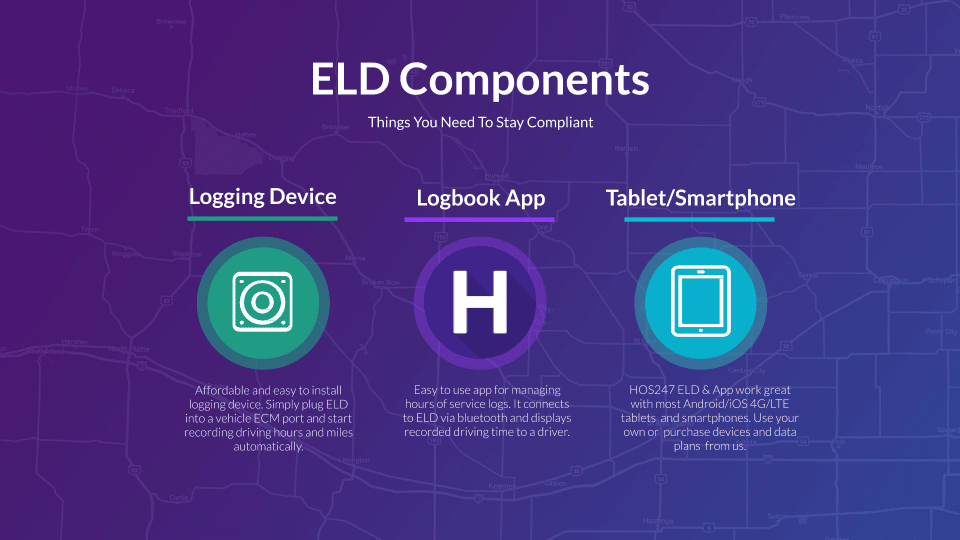
Fleet managers, owner-operators, and independent drivers need a reliable ELD solution. HOS247 steps in as an industry leader that can help users stay compliant with semi driver hours of service regulations, improve their logistics, and optimize their fleet management. Our electronic logbook is FMCSA-registered and our company is known for providing outstanding customer support. A few of the HOS247 ELD key features are:
- Automatic HOS. Our electronic logging device solution tracks semi truck drivers hours of service automatically, making it easy to adhere to current regulations. It also provides driving time, miles, and location records automatically.
- DOT Inspection Mode / Compliance Monitoring. Pass DOT inspections, avoid costly fines with our FMCSA-registered ELD, and monitor hours of service logs and DVIRs. All from the comfort of a phone or a tablet.
- Multiple HOS Rules & Exemptions. Stay compliant with multiple HOS rules such as Property/Passenger 60-hour/7-day & 70-hour/8-day.
- Compatible With Android & iOS. Download HOS247’s electronic logbook app from Apple Store or Google Play Store. The app is fully compatible with both operating systems.
- Electronic DVIR. Ensure vehicle safety with easy-to-create/edit electronic driver vehicle inspection reports.
- IFTA Reporting. Reduce human error and audit risk with automated IFTA state mileage calculations.
- ELD-Based Tracking. Gain full visibility of your fleet and improve your logistics and operations with the location history tracking system in HOS247’s electronic logging device.
Choosing the right ELD is about more than just avoiding fines; it’s about finding a system that fits seamlessly into your daily workflow. With HOS247, fleets gain a partner that simplifies the complex web of compliance, allowing drivers to focus on the road while the technology handles the regulations.

GPS Tracking For A Complete Solution
There’s a simple way to help keep a truck as safe as possible — GPS fleet tracking. At HOS247, we offer it as an add-on to our ELD solution to provide a complete product with advanced real-time GPS tracking telematics powered by 4G LTE Technology. Here are the main advantages of HOS247’s GPS fleet tracking:
- Faster connectivity. Our track ers’ 4G LTE Technology can help avoid service interruptions, speed up their connection, and enable route optimization.
- Increase fuel efficiency. Our GPS tracker comes with a telematics solution that provides vehicle speed information, which alerts when the speed limit is exceeded or when a truck is idle. Reducing unnecessary speeding and excessive idling times can help reduce fuel wastage.
- Provide accurate location-based information. With a GPS tracker, fleet managers can locate the vehicle closest to a particular location, which can help reduce dispatching time. An accurate location reading can also help optimize the company’s route planning and logistics.
- Improve vehicle security. Thanks to location-based data, the company can obtain the vehicle’s coordinates in case of theft or recover an item. This can also help managers track vehicles and receive alerts if the vehicle is being used after working hours.
An integrated GPS and ELD system transforms data into actionable business intelligence. By combining compliance logs with real-time location and vehicle health data, fleet managers can make smarter decisions that protect assets, reduce fuel costs, and improve customer satisfaction. HOS247’s 4G GPS tracking can help increase operational efficiency by providing complete control of any given vehicle in real time, preventing risks, and saving time and money.
Why Choose HOS247
By choosing HOS247 as an ELD provider, fleet managers, truckers, and owner-operators will obtain a top-rated solution with easy-to-use software and sturdy hardware designed to keep commercial vehicles running and compliant. And most importantly, at HOS247 we work tirelessly to provide our clients the biggest benefit: outstanding customer service 7 days a week. Here’s what HOS247 users will get:
- Top-rated ELD. Our FMCSA-approved electronic logging devices can help users stay compliant with semi truck hours of service in the United States, Canada, and Mexico.
- Reliable hardware. We focus on dependability. HOS247 ELD hardware was strategically designed to be sound and reliable in order to prevent mid-drive breakdowns. Also, it is easy to install with a hassle-free process. And in case something were to happen, HOS247’s high-quality support is always there to help.
- High-quality support. Our customer service is available to help 7 days a week. In addition, support can be provided in multiple languages, including English, Spanish, Polish, and Russian. This dedication and reliability are what makes HOS247 one of the top options in the ELD market.
- No hidden costs. With HOS247, there are no hidden costs. Everything is shown upfront, and it doesn’t matter if it’s just 1 vehicle or an entire fleet of 500 trucks.
- No long-term contracts. We offer two-week returns with no hassle. Also, with HOS247 you don’t need to commit to any long-term contracts and can cancel at any moment if you are not satisfied with the solution.
In an industry where downtime costs money, reliability is the most valuable feature of all. HOS247 delivers a stable, user-friendly platform backed by support that is actually there when you need it. It is a solution built to keep your trucks legal, your drivers happy, and your business moving forward.
Transitioning to a New ELD: A Step-by-Step Guide
Switching ELD providers can feel daunting, but the long-term benefits of a reliable system outweigh the temporary setup time. Here is how HOS247 makes the transition seamless:
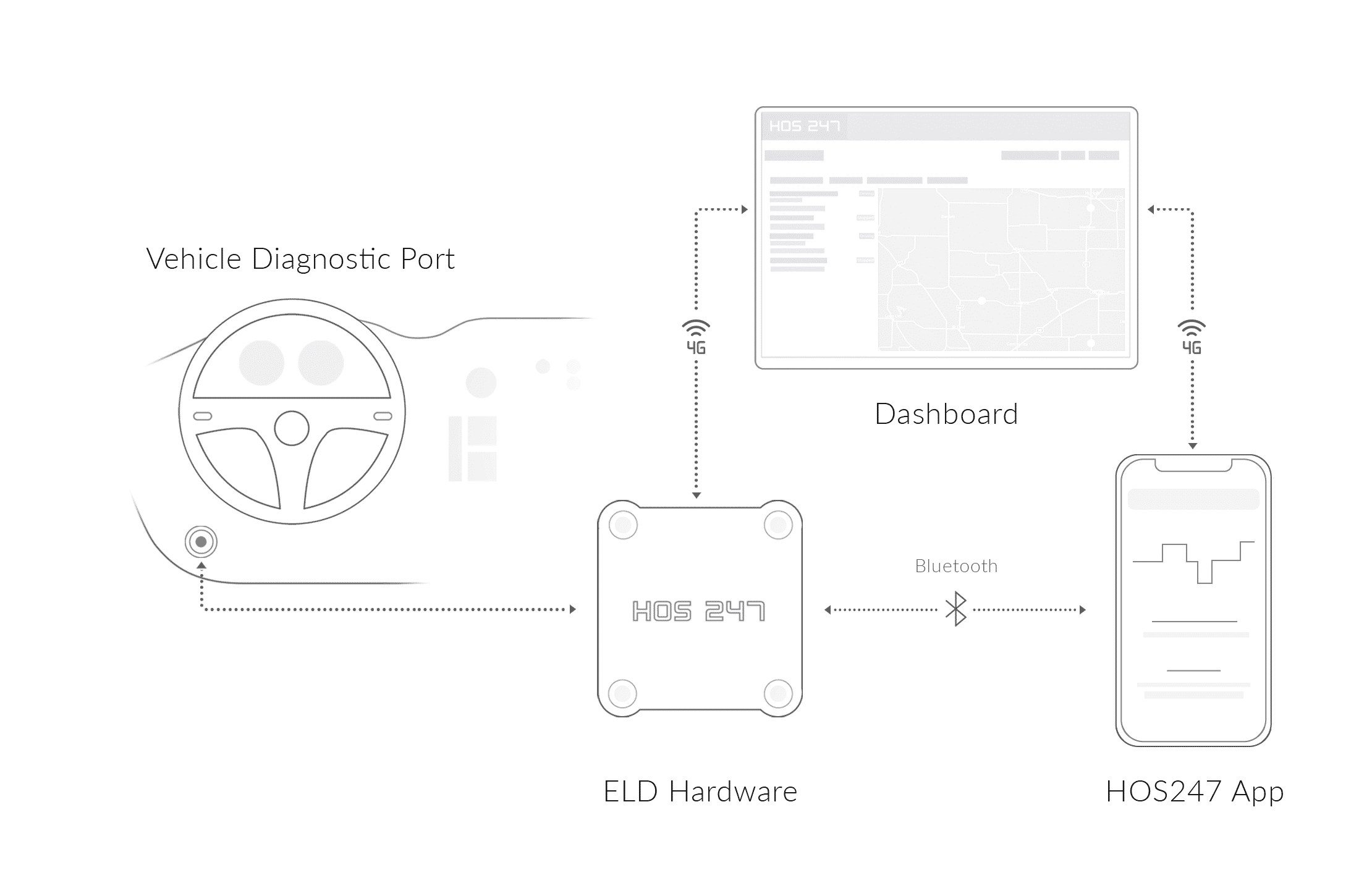
- Hardware evaluation. Determine if you need a simple plug-and-play OBD-II connection or a more permanent hardwired solution for older trucks.
- Data migration. Ensure your current logs are backed up. When you plug in the HOS247 device, it begins recording fresh, accurate data immediately.
- Driver training. Use the intuitive HOS247 app to walk drivers through “DOT Inspection Mode.” A driver who is confident during an inspection is much less likely to receive a “hustle” violation from an officer.
- Portal setup. Fleet managers can customize alerts for speeding, idling, and upcoming maintenance directly in the web-based portal.
Ultimately, the transition to a new ELD is more than just a hardware upgrade; it is a commitment to a more streamlined and transparent way of doing business. By following a structured implementation plan and choosing a partner like HOS247 that prioritizes ease of use and expert support, you can turn a potentially stressful regulatory requirement into a smooth operational advantage.
Conclusion
Semi driver hours of service regulations are the framework that keeps professional drivers safe and compliant on the road. While the basic 11-hour and 14-hour rules provide the structure, mastering the advanced exceptions — like the split sleeper berth or personal conveyance — is what allows a fleet to truly maximize efficiency without risking violations.
Success in this industry requires a balance of knowledge and the right tools. A reliable ELD system does not just record time; it simplifies the complexity of these rules, giving drivers confidence that their logs are accurate and audit-ready.
By choosing HOS247, fleets gain a dedicated partner committed to keeping trucks moving. With dependable hardware, an intuitive app designed for real-world trucking, and support that is always just a phone call away, HOS247 ensures that compliance is never a burden. Invest in a solution that works as hard as your drivers do, and keep your focus where it belongs: on the road ahead.
A Note to Our Readers on Compliance
This article is intended for informational and educational purposes only. It is not a substitute for official regulatory guidance or legal advice. HOS and ELD regulations are complex and subject to change and interpretation by enforcement officials. Please always refer to official sources for the most current and accurate information.

I’ve co-founded, built and managed several transportation-related businesses. Now, I’m a founder and CEO of HOS247 – an AI Transportation Platform for trucking companies, freight brokers and other logistics operations. We are transitioning old-style operations to technology-advanced logistics entities and help them to grow their businesses. ELDs (electronic logging devices), fleet tracking and management 2.0 combined with AI-powered dispatch tools.











Electronic logging devices (ELDs) have changed how truck drivers track their hours on the road, replacing paper logs with digital records. For team drivers sharing the wheel, using ELDs comes with extra challenges that solo drivers don’t face. Team drivers

Every minute you spend wrestling with logbook paperwork is a minute you’re not earning. That’s why having the right electronic logbook matters for your success on the road. As a trucker, you need an ELD that works as hard as

Vehicle Log Book App for Android and iOS Electronic logging devices are a legal requirement for commercial drivers. They are also useful to streamline operations, stay on top of fleet maintenance, and save carriers time and money. An essential part